





Chances are, if you’ve ever held a job, you’ll have experienced some form of employee onboarding. From the moment you walk into an office on your first day, there are a host of new faces to meet, processes to learn, and technology to set up — not to mention the tedious task of filling out a mountain of initial paperwork. All of these activities are part of employee onboarding at any company.
But what is employee onboarding, exactly?
미국인적자원개발협회(SHRM)에 따르면, 직원 온보딩(조직 사회화라고도 함)은 “신입 사원이 새로운 직무의 사회적·성과적 측면에 신속하고 원활하게 적응하도록 돕고, 조직 내에서 효과적으로 업무를 수행하는 데 필요한 태도, 지식, 기술 및 행동을 습득하도록 지원하는 과정”이다.
In short, employee onboarding involves the processes that help you ensure that your new hires get started on the right foot. These processes can be broken down into two categories:
- Formal onboarding encompasses the organized tasks and procedures that help a new employee adjust to his or her new position. Under formal onboarding, new hires are often segregated from existing employees to experience coordinated activities for orientation, in-classroom training, and socialization.
- Informal onboarding refers to the ad hoc and semi-organized activities by which a new employee learns about his or her new job. Informal onboarding can include job shadowing and impromptu one-on-one coaching or meetings with management and new colleagues, as well as the minutiae of getting started at a company, such as receiving badges and equipment.
Money well spent
Regardless of whether an organization chooses formal onboarding, informal onboarding, or a mix of both, getting new hires up to speed is an expensive task. According to management consultants Mark Stein and Lilith Christiansen in their book, Successful Onboarding, companies spend up to 30% of a new hire’s annual salary during the onboarding process.
While the expense of onboarding new employees can be daunting, it’s money that’s well spent — a centralized, properly resourced process of welcoming new employees may prevent early turnover for as many as 1 in 4 new hires. And the faster that your new hires feel welcomed and adjusted to their new roles, the faster that they can begin contributing value to your company.
As your workforce grows, your employees are more distributed than ever – you might find employees in the main office, others working fully remotely or working from home certain days of the week, and even frontline staff supporting customers. Gathering trainers and teams for in-person training is an inefficient process that takes up a staggering 85% of training budgets – a figure that’s quickly becoming untenable in the era of remote work.
Remote Employee Onboarding Best Practices
Given the expense of onboarding new recruits, how can large enterprises build time-sensitive training across a diverse set of roles, and deliver it to new recruits that may be remotely located across the country or even around the world?
The solution to scaling is video.
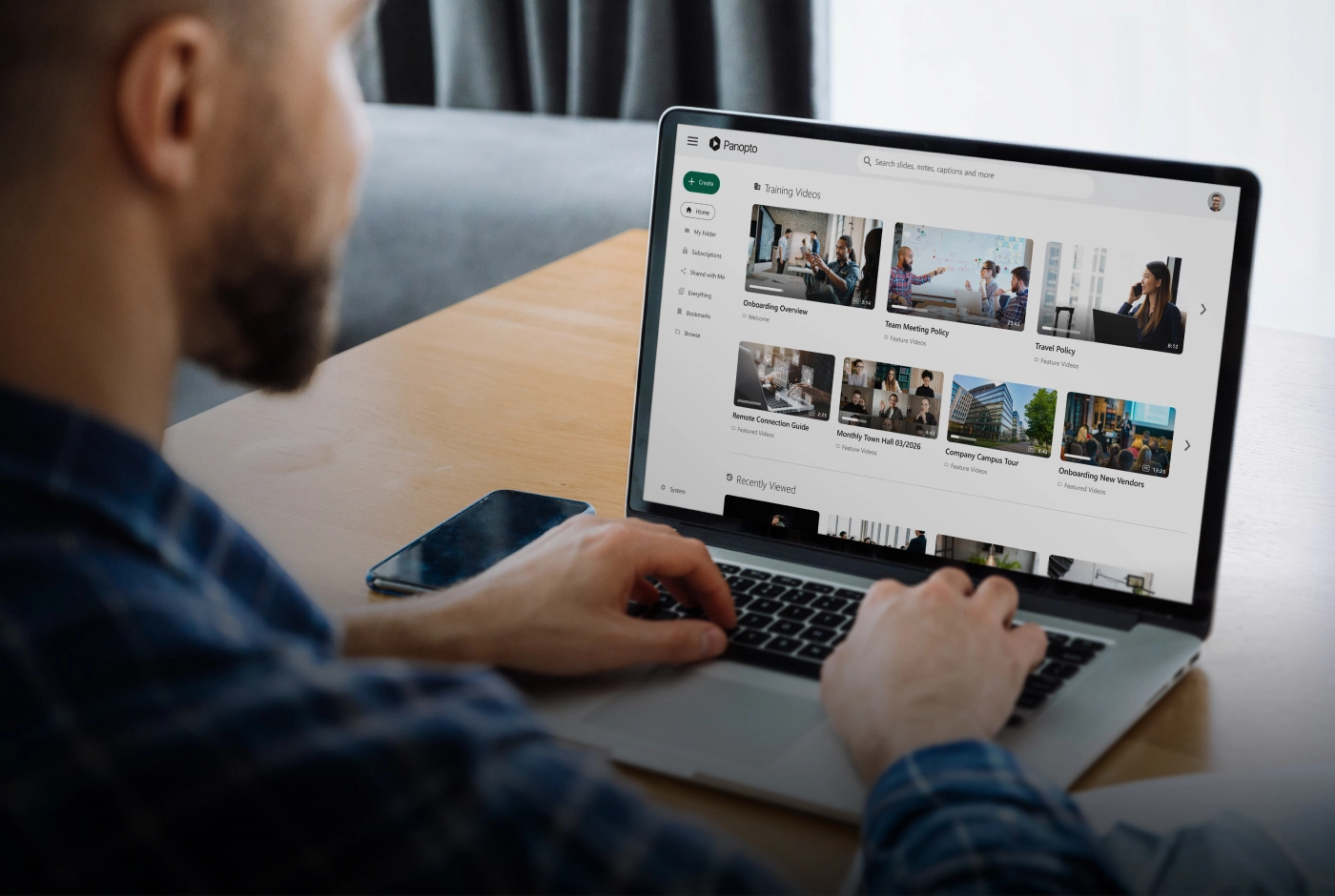
Video has already become the foundation for how we share knowledge in a distributed world, and many L&D leaders are leveraging video to conduct onboarding and training. Through the use of video, HR organizations have been able to improve employee onboarding in the following ways:
- Reduce training program costs. By substituting video for in-class trainings and smaller events, companies such as IBM and Microsoft have been able to save millions of dollars in travel and lodging alone.
- Improve knowledge retention. The use of video has been shown to improve people’s ability to remember concepts and details — with effects that actually increase over time. Additionally, enterprise video platforms enable people to search across an entire library of training videos, as well as search inside each video, for any word that was spoken or appeared on screen. This ability to search gives employees a searchable resource that enables them to find the information they need on-demand.
- Ensure consistency of training materials. For larger organizations or companies that are geographically dispersed, having multiple trainers can introduce challenges to providing a consistent onboarding experience for all new employees. Video solves this problem by ensuring that companies maintain a consistent, high-quality messaging standard regardless of who conducts the training.
- Help employees feel more engaged and connected. Establishing strong interpersonal networks and relationships is one of the most overlooked aspects of employee onboarding. Video can help expand the reach of your onboarding programs worldwide through the use of company and team introductions that can help your new hires place faces and personalities to the names they’ll see in their company directories and email inboxes.
Upgrade your employee onboarding experience with video
Panopto 신입 사원 온보딩 소프트웨어가 귀사의 신입 사원 교육을 어떻게 개선할 수 있는지 더 자세히 알아보시려면 최신 백서를 다운로드하세요. '온보딩 최적화 및 가속화를 위한 5가지 전략'