



- Webinar Recap
Beyond the Prompt: Key Webinar Insights on AI as a Strategic Thought Partner

The landscape of Artificial Intelligence in Learning and Development has reached a critical tipping point. It is no longer a question of whether organizations are introducing these tools, especially as AI adoption jumped from 55% to 78% in the last year alone. Instead, the focus has shifted to whether they are using it to move the needle on performance.
In a recent Panopto webinar, “AI as a Thought Partner: Designing Video Learning Content That Changes Work,” experts highlighted a massive gap in current implementations. While 78% of companies use AI, only 12% of employees receive enough training to actually improve their productivity at work.
Closing this gap requires moving past the “shortcut” mindset and embracing AI as a creative and strategic collaborator.
Driving Productivity Through Human-AI Synergy
A common concern in creative departments is that AI might minimize human talent. However, real-world applications suggest that AI enhances rather than replaces human expertise. At Global Lynx, integrating AI into the e-learning workflow evolved designers into “orchestrators” or “cinema directors” who define the vision while AI handles the technical execution.
By automating asset management and basic production, the team achieved a staggering 500% increase in productivity. Manuel Garcia, Director of Operations at Global Lynx, noted during the session: “True capability comes from blending human talent with AI enablement.” When the burden of manual asset management is lifted, professionals are freed to provide more value through high-level strategic activities.
From Autocomplete to Active Thought Partnership
The most transformative use of AI isn’t asking it to “write a course outline.” Instead, the real value lies in using it to “stress-test” one. When treated as a “thought partner,” AI functions as an objective critic that can evaluate learning objectives or suggest entry points for complex audience challenges.
As Inna Horvath, Product Marketing Manager at Panopto, explained during the webinar: “The real shift is viewing AI as a co-thinker and challenger, rather than just a ghostwriter.” This involves several key modes of interaction:
Curriculum Ideation: Instead of starting with a generic prompt, start with a question about why an audience is struggling to find the right entry point.
Scenario and Story Design: Using AI to build complex branching scenarios that allow learners to experience the real consequences of their decisions.
Objective Criticism: Asking AI to argue against a proposed instructional approach to find and fix weaknesses.
Designing for Behavioral Change
If people don’t remember the training, the behavioral change won’t happen. AI-powered video tools are now tackling the “robotic” feel of early AI content by introducing dialogue avatars and expressive gestures to drive engagement. This is vital in an era where learners are used to the fast-paced “infinite reel” of social media and disengage if content feels static.
Internal research and case studies highlighted during the session demonstrate that the impact of these high-fidelity tools is clearly measurable:
Engagement Growth: Organizations have seen nearly double the engagement from AI-generated video content.
Knowledge Retention: Institutions like Kazakh British Technical University reported 30% higher retention rates.
Cost Efficiency: Voiceover costs have been slashed by over 87%, allowing for rapid localization and scaling across multiple languages.
Replacing the “AI Taboo” with Transparent Experimentation
Perhaps the biggest hurdle isn’t technical, but cultural. Current data suggests that nearly 50% of employees use AI in secret, often due to a lack of clear guidance or fear of judgment. Manuel Garcia emphasized the importance of psychological safety in this transition, stating: “Learners need a safe environment where they can fail and experiment; once they feel comfortable with the tool, their motivation returns.”
To move forward, organizations can replace the “AI taboo” with an experimentation workflow. Leadership should model the behavior they want to see by sharing both successes and challenges to ensure AI adoption is a transparent, collaborative initiative.
The Bottom Line
AI is not a silver bullet that manages itself. Success requires clear intent, strong design principles, and human judgment to turn AI-generated materials into experiences employees actually use. Garcia warned: “Don’t expect a tool to manage your process; you still need a robust workflow and a solid management layer.”
In the fast-moving world of L&D, the goal is to use AI to create learning that is not just efficient, but memorable and meaningful. By shifting from task-based shortcuts to strategic thought partnership, L&D professionals can lead a transformation that fundamentally improves how people work.
Latest News
-

- Higher Education
Video Tool Sprawl in Community Colleges and the Case for Consolidation
It starts innocuously enough: one department begins storing lecture recordings in Zoom, another uses YouTube for course content, faculty in the nursing program upload skills demos to a shared Google Drive, or the distance education team purchases a standalone captioning tool to address an ADA complaint. Each of those decisions was reasonable in isolation, but…
Video Tool Sprawl in Community Colleges and the Case for Consolidation
-
- Remote Work
How Our Customers Made Panopto a G2 Spring 2026 Leader
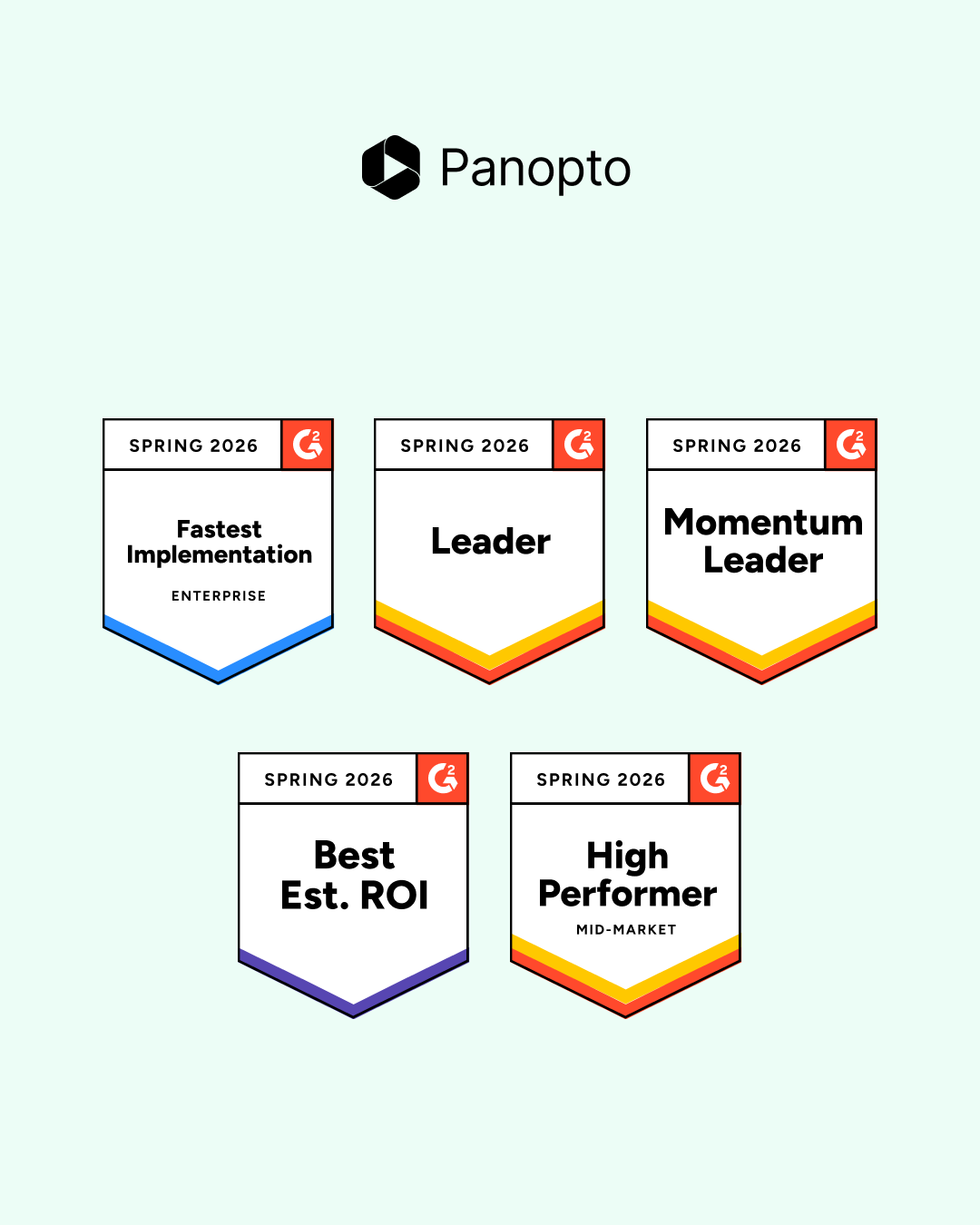
We’re proud to support the customers whose feedback and real-world outcomes led to Panopto being recognized with multiple G2 Spring 2026 badges. This season, Panopto earned Leader, Momentum Leader, High Performer, Fastest Implementation, and Best Estimated ROI badges across multiple G2 Spring 2026 Reports, based on its performance within the Video Communications, Video CMS, Virtual…
How Our Customers Made Panopto a G2 Spring 2026 Leader
-

- Enterprise Video Platform
Best Video Management Platforms for Training and L&D Teams in 2026
Most video platforms were built for marketing teams. They track clicks, conversions, and ad performance. That’s useful if you’re selling a product. It’s not useful if you’re training 5,000 employees on updated compliance procedures and need to know who actually watched the whole thing. Training teams have a different set of problems to solve. You…
Best Video Management Platforms for Training and L&D Teams in 2026