

Steps to Enhance Employee Onboarding Automation

A well-structured employee onboarding automation workflow sets the tone for a new hire’s experience and long-term success. Yet, many organizations still rely on outdated, manual processes that lead to inefficiencies, inconsistencies, and missed opportunities to engage new employees from day one.
Automation can transform onboarding processes for businesses. It streamlines administrative tasks and improves the experience for new hires, helping them feel welcomed and ready to contribute. In this post, we’ll discuss how automating your onboarding workflow saves time, enhances accuracy, and makes the onboarding journey more engaging for everyone.
The Challenges of Traditional Employee Onboarding
Traditional employee onboarding often relies on manual processes that can be time-consuming, error-prone, and inconsistent. These inefficiencies create challenges for both HR teams and new hires, ultimately impacting the overall onboarding experience.
Manual Processes in Employee Onboarding
One of the biggest onboarding hurdles is the administrative burden. Tasks like filling out forms and scheduling training sessions are repetitive and labor-intensive. This not only slows down the process but also diverts HR’s attention away from building meaningful connections with new employees.
Inconsistent Employee Onboarding Workflows
Inconsistencies across teams or locations present another challenge. Without a standardized employee onboarding workflow, new hires may receive varying levels of support, leading to confusion or a lack of clarity about their role, responsibilities, and the organization’s culture.
Improving the Employee Onboarding Experience
Finally, the lack of engagement in traditional onboarding processes can leave employees feeling disconnected. When onboarding focuses more on paperwork than on fostering a sense of belonging, organizations risk higher turnover and lower job satisfaction.
These challenges highlight the need for a more efficient, consistent, and engaging approach—one that automation can provide. By addressing these pain points, companies can create a seamless and welcoming employee onboarding experience that benefits both new hires and the organization as a whole.
Key Steps to Automate Your Employee Onboarding Workflow
Automating your employee onboarding workflow can transform how new hires are integrated into your organization. Here are the essential steps to get started:
Map Out Your Current Employee Onboarding Workflow
Begin by analyzing your current process. Identify repetitive and time-consuming tasks such as paperwork, IT provisioning, and scheduling. Mapping out these steps helps you pinpoint areas where automation can save time and reduce errors.
Choose the Right Employee Onboarding Automation Tools
Select a platform that integrates seamlessly with your existing HR systems. Look for tools that can automate tasks like sending welcome emails, collecting digital signatures, and assigning training modules. Ensure the solution supports scalability and customization for your organization’s unique needs.
Test and Monitor the Workflow
Before rolling out your automated process organization-wide, test it with a small group of hires to ensure it functions smoothly. Gather feedback and monitor the workflow for any issues or improvements needed.
Refine and Scale the Process
As your organization grows, continue refining your automated employee onboarding workflow to meet evolving needs. Use analytics from your tools to identify bottlenecks or gaps and make adjustments accordingly.
By automating key steps in your employee onboarding workflow, you can streamline the process, provide a consistent and engaging experience, and ensure new hires start their journey with confidence and clarity.
5 Best Practices for Employee Onboarding Automation
To maximize the impact of your automated employee onboarding workflow, follow these best practices for creating a seamless, engaging, and effective process:
1. Start with Simple Automations
Begin by automating repetitive administrative tasks like sending offer letters, collecting digital signatures, and assigning new hire paperwork. Focusing on these easy wins allows you to demonstrate immediate value while laying the foundation for more complex automations.
2. Maintain a Human Touch
While automation streamlines processes, it’s essential to preserve the personal elements of onboarding. Incorporate automated reminders for managers to check in with new hires or schedule team introductions. A personal touch enhances the employee onboarding experience and fosters stronger connections.
3. Ensure Consistency Across Teams
Use automation to standardize processes, ensuring that every new hire, regardless of location or role, receives the same high-quality onboarding. This eliminates discrepancies and builds a more cohesive organizational culture.
4. Gather Feedback and Monitor Performance
Collect feedback from new hires and HR teams to assess the effectiveness of your automated processes. Use analytics from your onboarding tools to identify areas for improvement and track progress against your onboarding goals.
5. Integrate Training and Development
Seamlessly integrate training modules into your automated workflow. Assign role-specific training videos, tasks, or resources as part of the onboarding process to set employees up for success from day one.
By balancing automation with personalization, ensuring consistency, and regularly refining your workflows, you can create a scalable and impactful employee onboarding automation process that benefits both new hires and your organization.
Transform Your Employee Onboarding Workflow with Automation
Automation is the key to creating a more efficient, consistent, and engaging employee onboarding workflow. By automating repetitive tasks, standardizing processes, and integrating personalized elements, you can significantly enhance the employee onboarding experience for new hires while saving time and resources.
An automated workflow ensures every new employee starts their journey with clarity, confidence, and the tools they need to succeed. Ready to elevate your onboarding process? Embrace automation to streamline your efforts, boost engagement, and set your organization up for long-term success. Start by seeing Panopto in action with a personalized demo.
Latest News
-

- Higher Education
Video Tool Sprawl in Community Colleges and the Case for Consolidation
It starts innocuously enough: one department begins storing lecture recordings in Zoom, another uses YouTube for course content, faculty in the nursing program upload skills demos to a shared Google Drive, or the distance education team purchases a standalone captioning tool to address an ADA complaint. Each of those decisions was reasonable in isolation, but…
Video Tool Sprawl in Community Colleges and the Case for Consolidation
-
- Remote Work
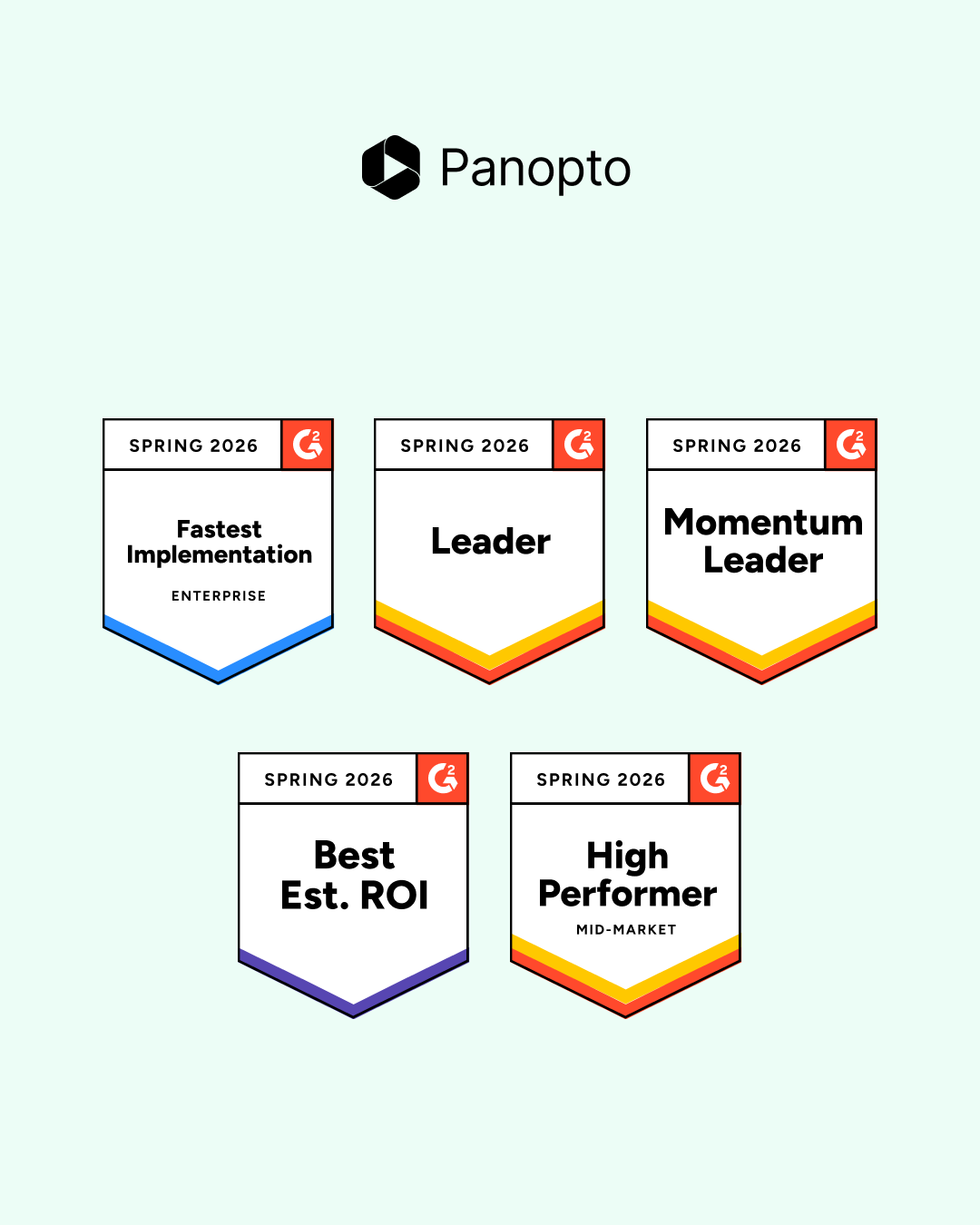
How Our Customers Made Panopto a G2 Spring 2026 Leader
We’re proud to support the customers whose feedback and real-world outcomes led to Panopto being recognized with multiple G2 Spring 2026 badges. This season, Panopto earned Leader, Momentum Leader, High Performer, Fastest Implementation, and Best Estimated ROI badges across multiple G2 Spring 2026 Reports, based on its performance within the Video Communications, Video CMS, Virtual…
How Our Customers Made Panopto a G2 Spring 2026 Leader
-

- Enterprise Video Platform
Best Video Management Platforms for Training and L&D Teams in 2026
Most video platforms were built for marketing teams. They track clicks, conversions, and ad performance. That’s useful if you’re selling a product. It’s not useful if you’re training 5,000 employees on updated compliance procedures and need to know who actually watched the whole thing. Training teams have a different set of problems to solve. You…
Best Video Management Platforms for Training and L&D Teams in 2026