
- Webinar Recap
WCAG 2.1 Level AA Video Accessibility: Proven Strategies from Leading Universities

Video has become essential to teaching and learning across higher education, but accessibility is often treated as an afterthought rather than a design principle. As institutions prepare for ADA Title II digital accessibility requirements, the question isn’t whether to make video accessible, but how to do it sustainably at scale.
WCAG 2.1 Level AA has emerged as the standard institutions must meet to ensure video content is perceivable, operable, understandable, and robust for all learners. These guidelines encompass everything from captions and audio descriptions to keyboard navigation and assistive technology compatibility. While the requirements are clear, the path to implementation varies significantly across institutions, and the most successful approaches share common patterns.
Recent insights from the latest webinar, featuring accessibility leaders at the University of Washington and Boise State University reveal a clear pattern: institutions succeeding with accessible video focus on the fundamentals first, build faculty capacity gradually, and use technology strategically rather than expecting it to solve everything.
Starting with the 80%
Rather than attempting comprehensive accessibility transformation overnight, the University of Washington identified which requirements would impact the broadest range of content. El Schofield, Team Lead for Service Management at UW IT, describes their practical approach: “The 80% of the work that is straightforward and the 20% that is really complicated—focusing on the 80% has really helped a lot because we’re able to start the conversation with everybody on campus about the WCAG requirements without sharing the whole list.”
Instead of overwhelming faculty with comprehensive accessibility standards, UW focused on the essentials that apply to most content: what happens in documents, on web pages, and in instructional videos. This targeted approach creates momentum while building institutional knowledge that can expand to more complex cases over time.
Design Decisions That Matter
WCAG compliance starts with intentional content creation, not remediation after the fact. LaKell Archer, Instructional Technologist at Boise State University, emphasizes the importance of intentional narration: “Narrate what you’re demonstrating on screen and avoid saying vague things like ‘Click here,’ or ‘Look at this.’ Instead, describe what it is that you’re speaking about.”
This approach does double duty: it eliminates the need for separate audio descriptions later while making content clearer for all learners. Similarly, attention to visual contrast between backgrounds and text makes a substantial difference for students with visual impairments. These aren’t burdensome extra steps; they’re design principles that align with WCAG 2.1 Level AA requirements while improving clarity universally.
Technology as an Enabler, Not a Solution
Meeting WCAG 2.1 Level AA standards requires platforms built for accessibility from the ground up. Simona Fallavollita, Senior Director of Product Management at Panopto, outlines the technical requirements: “Captions, audio descriptions for those who are visually impaired, media players that are accessible in terms of being able to leverage keyboards to control the media player, being operable with other assistive technology like JAWS, making all those things usable for the end user.”
The right platform makes compliance manageable rather than overwhelming. Laura Baldwin, Service Manager for IT at the University of Washington, notes the practical impact: “Panopto is one of the few tools that supports audio descriptions, and we’re really excited that we’re gonna be able to order them with vendors. It’s also been really easy for us to work with our disability office to request captions for students who need that accommodation.”
When accessibility features are built into the platform rather than requiring workarounds, institutions can scale support without reinventing processes for each accommodation request.
Accessible Design Benefits Everyone
The institutions seeing the strongest results recognize that accessible video isn’t just about compliance; it’s about better learning design that aligns with universal design principles embedded in WCAG standards. When video includes clear structure, searchable captions, and intentional narration, all students benefit: those catching up after missed class, those revising for assessments, those working asynchronously across time zones, and those processing information in different ways.
This is universal design in action: solutions created for specific accessibility needs improving the experience for everyone while meeting WCAG 2.1 Level AA requirements.
Building Sustainable Practices
Sustainable accessibility requires institutional commitment to WCAG 2.1 Level AA as a baseline standard, not an aspirational goal. Institutions are finding success by:
- Starting with core accessibility requirements that apply broadly across content types
- Equipping faculty with clear documentation and guidance to support accessible content creation
- Creating feedback loops between disability services and instructional technology teams
- Building accessibility evaluation into vendor procurement processes to ensure new tools meet standards
The goal is building systems where WCAG 2.1 Level AA compliance becomes increasingly routine rather than exceptional effort.
Moving Forward
As accessibility requirements evolve and enforcement of ADA Title II standards accelerates, institutions that treat WCAG 2.1 Level AA as a design principle rather than a compliance checkbox will be best positioned to support all learners. The technology exists. The frameworks are proven. What matters now is implementation that balances ambition with sustainability, automation with quality, and standardization with flexibility.
When accessibility is built into video from creation through delivery, institutions don’t just meet compliance requirements — they create learning environments where every student can engage with content effectively.
Latest News
-
- Remote Work
How Our Customers Made Panopto a G2 Spring 2026 Leader
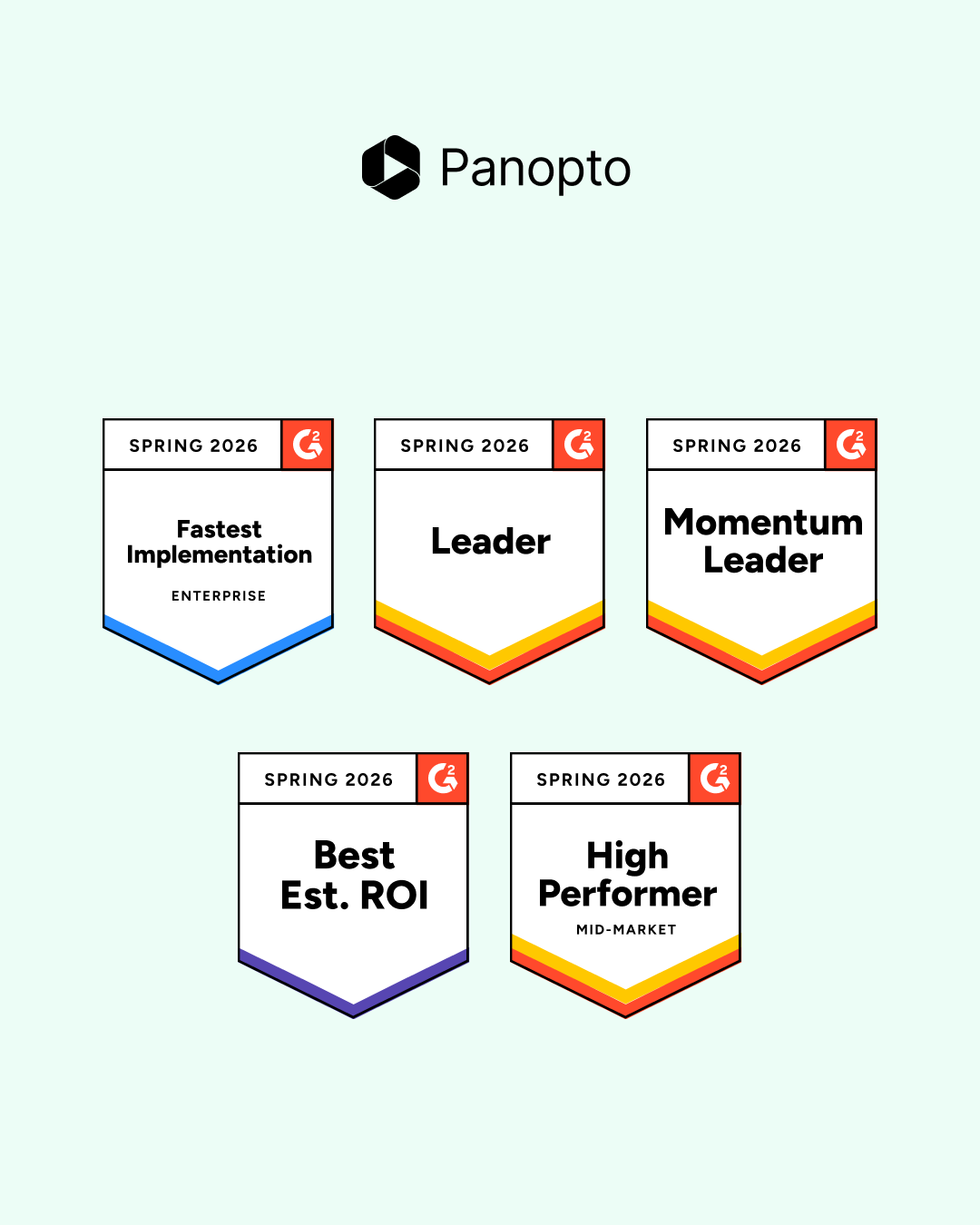
We’re proud to support the customers whose feedback and real-world outcomes led to Panopto being recognized with multiple G2 Spring 2026 badges. This season, Panopto earned Leader, Momentum Leader, High Performer, Fastest Implementation, and Best Estimated ROI badges across multiple G2 Spring 2026 Reports, based on its performance within the Video Communications, Video CMS, Virtual…
How Our Customers Made Panopto a G2 Spring 2026 Leader
-

- Enterprise Video Platform
Best Video Management Platforms for Training and L&D Teams in 2026
Most video platforms were built for marketing teams. They track clicks, conversions, and ad performance. That’s useful if you’re selling a product. It’s not useful if you’re training 5,000 employees on updated compliance procedures and need to know who actually watched the whole thing. Training teams have a different set of problems to solve. You…
Best Video Management Platforms for Training and L&D Teams in 2026
-

- Webinar Recap
Beyond the Prompt: Key Webinar Insights on AI as a Strategic Thought Partner
The landscape of Artificial Intelligence in Learning and Development has reached a critical tipping point. It is no longer a question of whether organizations are introducing these tools, especially as AI adoption jumped from 55% to 78% in the last year alone. Instead, the focus has shifted to whether they are using it to move…
Beyond the Prompt: Key Webinar Insights on AI as a Strategic Thought Partner