
- Enterprise Video Platform
Best Video Management Platforms for Training and L&D Teams in 2026

Most video platforms were built for marketing teams. They track clicks, conversions, and ad performance. That’s useful if you’re selling a product. It’s not useful if you’re training 5,000 employees on updated compliance procedures and need to know who actually watched the whole thing.
Training teams have a different set of problems to solve. You need people to find the right video, watch it to completion, and prove they understood the material. You need that data to flow back into your LMS. And you need all of this to work without requiring a dedicated AV team every time someone records a walkthrough.
This guide covers what L&D teams should actually look for in a video management platform for training, how the leading platforms compare, and where specific tools fall short. If you’re evaluating enterprise video platforms right now, start here.
A quick note on categories. Video platforms for training generally fall into three buckets: management systems that store, secure, and track content; creation tools for recording and editing; and AI generators that build videos from scripts. This comparison focuses on management platforms, where training content lives, gets found, and gets measured.
What Training Teams Need from a Video Platform
When L&D teams evaluate video management solutions, they’re looking for specific capabilities that go well beyond basic hosting. Here’s what matters most.
Core Analytics & Engagement Tracking
Managers want granular engagement analytics to see exactly how learners interact with training content. That includes second-by-second insights like heat maps showing where viewers rewatch or skip ahead. Retention trends and drop-off points help identify which sections need improvement.
Completion rates matter for compliance, but individual viewer tracking is what separates real platforms from basic hosting services. Many teams also look for built-in interactivity, such as embedded quizzes and polls to validate comprehension as people watch.
Integration Capabilities
CRM and LMS integration consistently ranks as a critical factor with what teams want out of a video platform. Training videos should embed directly in your existing learning management system, whether that’s Moodle, Canvas, Blackboard, or your proprietary platform.
Most LMS platforms use standards like SCORM (Sharable Content Object Reference Model) to track learning content. When your video platform integrates properly with your LMS, completion status, time spent, and quiz scores can flow directly into your LMS gradebook without manual reporting. This integration is what separates enterprise training platforms from basic video hosting.
Professional Hosting & Control
Users want professional, customizable hosting with reliable playback. That means ad-free branded players and control over where and how videos are embedded. Nobody wants training content interrupted by ads or hosted on platforms that could change policies overnight.
Strong privacy and security controls protect both the content and learner data. API access matters too because it supports advanced workflows and custom integrations that scale with your organization.
Creation & Ease of Use
Built-in creation tools matter because teams want to produce training content quickly without extra software. Screen capture, webcam recording, and in-browser editing let subject matter experts create content themselves. They shouldn’t need an AV team just to document a process or update a compliance video; they should be able to do it themselves.
Many platforms now offer AI-assisted editing and template-based creation to speed up production and allow matter experts to get their content out much faster than before. When SMEs can create their own content, training libraries stay current.
Personalization & Interactivity
For training use cases, teams prioritize personalization and in-video engagement that keeps learners active, not passive. Personalized video messaging helps scale one-on-one communication at speed, especially for coaching, onboarding, and targeted updates.
Embedded interactive elements and in-player calls-to-action then reinforce key moments, prompt participation, and guide learners smoothly to the right next steps.
Measurement of Learning Outcomes
Video platforms for training and L&D need the ability to measure the learning process through graded quizzes and the amount of video viewed. Sometimes this is a compliance issue; sometimes it’s to help instructors understand whether people understand the material.
Security & Compliance
Buyers prioritize enterprise-grade protection for both video content and learner data. SSO, role-based permissions, secure sharing, and audit trails are baseline requirements. Clear compliance and governance controls matter too: data retention policies, access logging, and policy enforcement to satisfy IT and regulatory requirements.
Accessibility & Inclusive Diversity
Training teams need accessibility built in by default. Captions and transcripts aren’t optional anymore. Screen-reader support, keyboard navigation, and flexible playback controls across devices ensure everyone can learn.
Searchable transcripts and multilingual captioning support global learners and meet accessibility standards with minimal manual effort. This isn’t about checking a compliance box. It’s about making training actually usable for your entire workforce.
The goal is a single source of truth for training videos. One place where content is created, stored, secured, searched, and measured.
Learn more: Video CMS Features | LMS Integrations
Video Management Platforms vs. Video Creation Tools
Video platforms for training fall into two categories, and choosing the wrong type is a common mistake. Let’s be clear about the difference.
The Core Difference
Video Management Platforms, such as Panopto or Kaltura, store, organize, secure, and track video at scale. They’re built around buyer priorities: analytics, integrations, security, interactivity, and learning outcomes.
These platforms are built to support ongoing training libraries, not just one-off recordings, so content stays organized, discoverable, and easy to reuse over time. This is where training truly lives, with full search and metadata, measurable engagement and outcomes, and the governance controls needed to manage access, updates, and compliance at scale.
Video Creation Tools such as Loom, Wistia, or Synthesia are optimized for recording or generating video content. They’re great at what they do, but they’re not built for structured training programs. You’ll find limited or no LMS integration, basic completion tracking at best, and minimal library management. The output of videos created on these platforms still needs a home where the videos are all accessible.
Why Creation Tools Fall Short for Training
| Capability | Management Platforms | Creation Tools |
|---|---|---|
| Searchable library | ✓ Full ASR/OCR | Basic or none |
| Scales to 1000s of videos | ✓ Built for it | Gets unwieldy |
| LMS integration | ✓ Native | Limited or none |
| Completion tracking | ✓ Individual-level | Views only |
| Security & permissions | ✓ Role-based | Limited |
| Analytics depth | ✓ Engagement + outcomes | Engagement only |
Where Creation Tools Fit In
Loom is great for async communication and quick screen recordings. Many teams use Loom for informal updates or simple how-to videos when helping out colleagues or employees. It’s fast and simple, but it’s not where you’d store your compliance library.
Wistia was built for marketing videos with lead generation analytics. It tracks conversions, not completions. It’s the right choice for customer-facing content, not employee training.
Synthesia and other AI generators create videos from text, which is useful for rapid production. But the output still needs storage, search, and tracking somewhere. These tools solve the creation problem, not the management problem.
These tools solve adjacent problems. They’re complements to a video management platform, but definitely not replacements.
Bridging the Difference
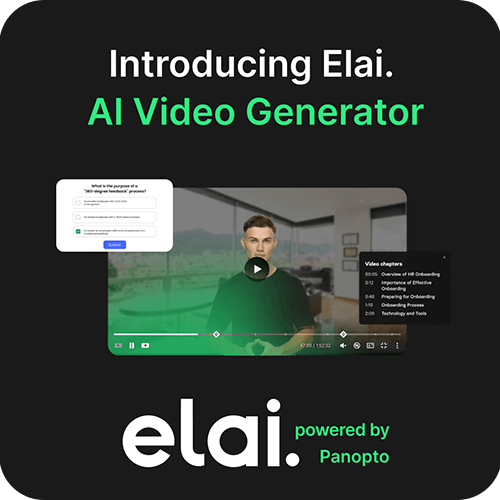
Panopto now includes Elai, an AI-powered video creation platform that turns text, slides, or AI prompts into professional interactive training videos. This integration means teams can scale smarter and move faster to create and manage training content in one platform. You can generate AI videos using a library of 500+ avatars, over 450 voices and 75 languages, then immediately organize, secure, and track them within Panopto’s video management system. It’s the rare case where creation and management come together without forcing teams to manage multiple tools.
Panopto: Purpose-Built for Training
Panopto was originally developed for education and evolved for enterprise use. That origin shows in how the platform handles training workflows.
Smart Search
AI-powered search indexes spoken words and on-screen text across your entire video library. Employees don’t just find the right video; they also find the exact moment they need within that video. This is better than keyword searching; it’s a full-text search of everything said and shown.
When someone searches for “quarterly reporting process” in Panopto, they get results showing exactly when and where that topic was discussed, even if those exact words weren’t in the video title or description.
Built for Learning Workflows
Native lecture capture and screen recording mean subject matter experts can create content without special equipment. Multi-camera support handles demonstrations and presentations that require multiple angles.
The platform handles the recording, syncing, and publishing automatically. SMEs focus on teaching, not production logistics.
Completion Tracking for Compliance
Comprehensive analytics and reporting measure video engagement and learning outcomes. Audit trails show who watched what and when. That’s critical for compliance training, where you need to prove completion.
Individual viewer data tracks not just whether someone watched, but how they engaged. Did they skip sections? Rewatch difficult parts? Complete embedded quizzes? That information helps improve training effectiveness in the future.
LMS Integration
Extensive integration capabilities with learning management systems mean videos are embedded directly in courses. Completion data syncs to gradebooks automatically, and learners stay in their familiar LMS environment while accessing Panopto’s advanced video features.
Integration with CRM and business applications extends beyond the LMS. Training data flows where you need it.
AI That Serves Learning
Elai integration creates training videos from slides, AI prompts, or scripts without traditional recording. This speeds up content production significantly. AI-powered search also helps employees find answers fast when they’re trying to complete a task.
Create interactive videos enabling active learning through features like branching scenarios and multiple types of quizzes you can embed into your videos.
Best for: Just-in-time training, compliance training, employee onboarding, and knowledge management.
Verified customers: Qualcomm uses Panopto to scale technical training globally. The University of Washington relies on it for hybrid learning. Ingersoll Rand uses it to share knowledge across 46,000 employees in hundreds of facilities. UNLV built its lecture capture program on Panopto.
How Other Platforms Compare
Kaltura
Kaltura is an API-first video platform that’s highly customizable. The strength here is flexibility for teams with dedicated development resources. LTI support is strong, which matters for educational institutions.
The consideration: Kaltura requires technical expertise to get the most value. Pricing can be complex depending on your configuration. You’ll need IT resources to manage customization and ongoing maintenance.
Best for: Large universities or enterprises with dedicated IT teams who need custom workflows.
vs. Panopto: More setup, more flexibility. Panopto is a turnkey solution for training teams without development resources.
Brightcove
Brightcove is a video platform built for marketing and media distribution. Its strengths are monetization, ad insertion, and external audience reach. If you’re distributing video to customers or prospects, Brightcove has the tools for that.
Best for: Marketing teams, media companies, or customer-facing content.
vs. Panopto: Between Brightcove and Panopto, they do different jobs entirely. Brightcove distributes to external audiences, while Panopto manages internal training.
Vimeo Enterprise
Vimeo Enterprise focuses on corporate communications. The UI is clean, and it handles town halls, leadership communications, and Zoom integration well.
Gaps for training: Weaker LMS integration compared to purpose-built learning platforms. Limited completion verification makes it harder to prove compliance. Security controls are less granular.
Best for: Marketing teams, customer-facing video, branded content, public-facing live events.
vs. Panopto: Strong for communications, less specialized for formal training programs with compliance requirements, which Panopto excels in.
Quick Comparison Table
| Capability | Panopto | Kaltura | Brightcove | Vimeo Enterprise |
|---|---|---|---|---|
| In-video search (ASR/OCR) | Advanced | Depends on modules | No | Limited |
| Native recording tools | Yes | Yes | Yes | Yes |
| LMS integration | Yes | Yes | Limited | Unknown |
| Completion tracking | Yes | Yes | Yes | Yes |
| Enterprise security | Yes | Yes | Yes | Yes |
| AI features | Search + Creation (Elai) | Add-ons (Content Lab, Genie) | AI-Suite (New) | Summaries |
| Best for | Training, L&D, Education | Custom workflows | Marketing/Media | Corporate communications |
How to Choose the Right Platform
The best video management platform for training depends on what your team actually needs to accomplish. If your goals include onboarding, compliance, or structured enablement, platforms purpose-built for training workflows (like Panopto) tend to rise to the top quickly. Here are the questions worth asking before you commit.
What’s your primary use case? If it’s formal training, compliance, or onboarding, you need a platform built for learning workflows, not one adapted from a marketing or communications tool. Prioritize native LMS integration, SCORM support, and individual completion tracking, areas where Panopto is purpose-built from day one.
How technical is your team? If you have developers who can build custom integrations and maintain them, a flexible API-first platform like Kaltura might work. If your training team needs to be self-sufficient, a turnkey SCORM video platform with built-in recording and editing will save months of setup time. This is where Panopto is typically the simplest path from setup to outcomes.
What does your video library look like in two years? Ten videos are easy to manage anywhere. Ten thousand videos need a real video CMS for learning with robust search, folder structures, permissions, and analytics. Plan for where you’re going, not where you are today. A platform like Panopto is built to keep content findable, governed, and measurable as volume grows.
Do you need to prove completion? For regulated industries or compliance-heavy organizations, “we uploaded a video” isn’t enough. You need verifiable audit trails showing who watched what, when, and for how long. Prioritize platforms like Panopto, which give you that data natively.
Platform fit matters more than feature count. A tool that does the right ten things well will outperform one that does fifty things at a surface level.
Conclusion
Training teams have specific requirements that most general-purpose video platforms weren’t built to address. Searchability across spoken and on-screen content, individual completion tracking, native LMS integration, and enterprise security aren’t optional. They’re the baseline.
The platforms that serve L&D teams best are the ones designed around how learning actually works, not how marketing content gets distributed. Panopto was built for this exact use case, from its origins in education to its current role as an enterprise video platform for training, onboarding, compliance, and knowledge sharing.
If you’re evaluating video management platforms for your training program, see Panopto in action with a free demo to test it with your own content.
Frequently Asked Questions
What’s the difference between a video management platform and a video hosting service?
Video hosting services store and stream your files. Video management platforms add organization, search, permissions, analytics, and integrations on top of hosting. It’s the difference between a file server and a content management system. Hosting is just storage and management is a complete workflow.
Do I need SCORM compliance for training videos?
If you’re tracking training in an LMS, you need a platform that integrates properly with your LMS standards. SCORM and other learning standards help ensure completion data, time spent, and quiz scores sync to your LMS gradebook. Without proper integration, you’re manually reporting completion or relying on learners to self-report. Neither scales well. Look for platforms with native LMS integration that handles data synchronization automatically.
What’s the best video platform for compliance training?
Look for platforms with individual viewer tracking, version control, and audit trails. Panopto and Kaltura both handle compliance requirements well. The key is proving who watched which version of the training and when. Marketing platforms like Wistia weren’t built for this use case.
How do employees search inside training videos?
Advanced platforms use automatic speech recognition (ASR) and optical character recognition (OCR) to index everything said and shown on screen. Employees search by keyword and jump directly to relevant moments. This turns hour-long videos into searchable knowledge bases instead of content you have to watch start to finish.
Can I track whether employees actually watched a training video?
Yes, but the depth varies by platform. Basic platforms show views and completion rates. Advanced platforms show second-by-second engagement, drop-off points, rewatched sections, quiz results, and time spent. For compliance purposes, you want individual viewer data with timestamps, not just aggregate metrics.
What integrations should a training video platform have?
At minimum, it should have your LMS (Moodle, Canvas, Blackboard, D2L), SSO provider (Okta, Azure AD), and video conferencing tools (Zoom, Teams). Many teams also need CRM integration, calendar systems, and business intelligence tools. API access lets you build custom integrations for specialized needs.
Is AI-generated video good enough for training?
For certain use cases, absolutely. AI video creation works well for policy updates, process documentation, and standardized training that doesn’t require human presence on camera. It’s fast and cost-effective. But it’s not a replacement for all training videos. Demonstrations, hands-on tutorials, and personality-driven content still benefit from traditional recording. The best approach uses both methods depending on the specific training need.
Latest News
-

- Higher Education
Video Tool Sprawl in Community Colleges and the Case for Consolidation
It starts innocuously enough: one department begins storing lecture recordings in Zoom, another uses YouTube for course content, faculty in the nursing program upload skills demos to a shared Google Drive, or the distance education team purchases a standalone captioning tool to address an ADA complaint. Each of those decisions was reasonable in isolation, but…
Video Tool Sprawl in Community Colleges and the Case for Consolidation
-
- Remote Work
How Our Customers Made Panopto a G2 Spring 2026 Leader
We’re proud to support the customers whose feedback and real-world outcomes led to Panopto being recognized with multiple G2 Spring 2026 badges. This season, Panopto earned Leader, Momentum Leader, High Performer, Fastest Implementation, and Best Estimated ROI badges across multiple G2 Spring 2026 Reports, based on its performance within the Video Communications, Video CMS, Virtual…
How Our Customers Made Panopto a G2 Spring 2026 Leader
-

- Webinar Recap
Beyond the Prompt: Key Webinar Insights on AI as a Strategic Thought Partner
The landscape of Artificial Intelligence in Learning and Development has reached a critical tipping point. It is no longer a question of whether organizations are introducing these tools, especially as AI adoption jumped from 55% to 78% in the last year alone. Instead, the focus has shifted to whether they are using it to move…
Beyond the Prompt: Key Webinar Insights on AI as a Strategic Thought Partner