








AI tools can turn a script into a narrated training video with an avatar in minutes. They work well for policy updates, onboarding basics and content that changes often. For hands-on skills, a recording of your own expert usually teaches better.
The strongest programs use both and keep everything in one searchable library. Panopto’s AI Video Studio is the AI side of that; its video training page covers the library.
This guide covers when to use AI and when to record, what to look for in an AI training video tool before you buy one, and the five steps from a slide deck to a tracked, searchable training video.
Why the old way of making training videos does not scale
A training video used to mean a storyboard, a script, a presenter, a camera, an editor and a few weeks. That works for the annual compliance module. It does not work for the policy that changed on Tuesday, the new feature the support team needs to explain by Friday, or the procedure that is different at each of your twelve sites.
The budget pressure runs the other way. U.S. organizations spent $102.8 billion on training in 2025, including $22.1 billion on travel, facilities and equipment, and the average employee received 40 hours of training. Most of that was delivered live, which means most of it has to be delivered again next year.
AI video creation changes two numbers: the time from “we need a video” to “it’s published”, and the cost of updating it when something changes.
It does not change what makes training work, which is still a clear explanation of one thing, in a place people can find it, with a record that they watched it.
AI avatar or your own expert?
Use the rule of thumb below. The question is what the video has to show.
Use AI when the content is the words.
Policy updates, process overviews, onboarding basics, product knowledge, compliance refreshers and anything that lives in a slide deck or a document.
The script is the training; the avatar reads it, consistently, in every language, and the video is re-rendered in minutes when the policy changes.
Record your own expert when the content is the hands.
Equipment setup, a clinical procedure, a repair, a software workflow with a hundred small clicks, a sales call.
A screen recording or a phone video of the person who does it best shows what no script can, and it carries the credibility of a colleague.
Use both when the program is bigger than one video.
Most training libraries end up as an AI-built layer of standard content over a recorded layer of expert demonstrations, with the whole thing searchable in one place.
What to look for in an AI training video tool
- Script to video. Can it build a video from a PowerPoint, a PDF, a document or a plain-text prompt, and does it read speaker notes as narration? Can you start from a template?
- Languages. Can one video be translated into the languages your workforce speaks, with the narration and the captions re-synced, without re-recording? How many languages, and can it clone a presenter’s voice?
- Presenter options. Avatars, voiceover only, screen recording with narration, or a mix. Avatars should be an option, not a requirement, and licensed.
- Brand control. Templates, a brand kit, your fonts and colors, so the output looks like your training and not the vendor’s demo.
- Editing. Can you change one scene’s script and re-render that scene, leaving the rest of the video and its link untouched? That is the difference between maintaining a library and rebuilding it.
- Interactivity. Quizzes, knowledge checks, branching scenarios and chapters built in the same editor, so the video teaches rather than plays.
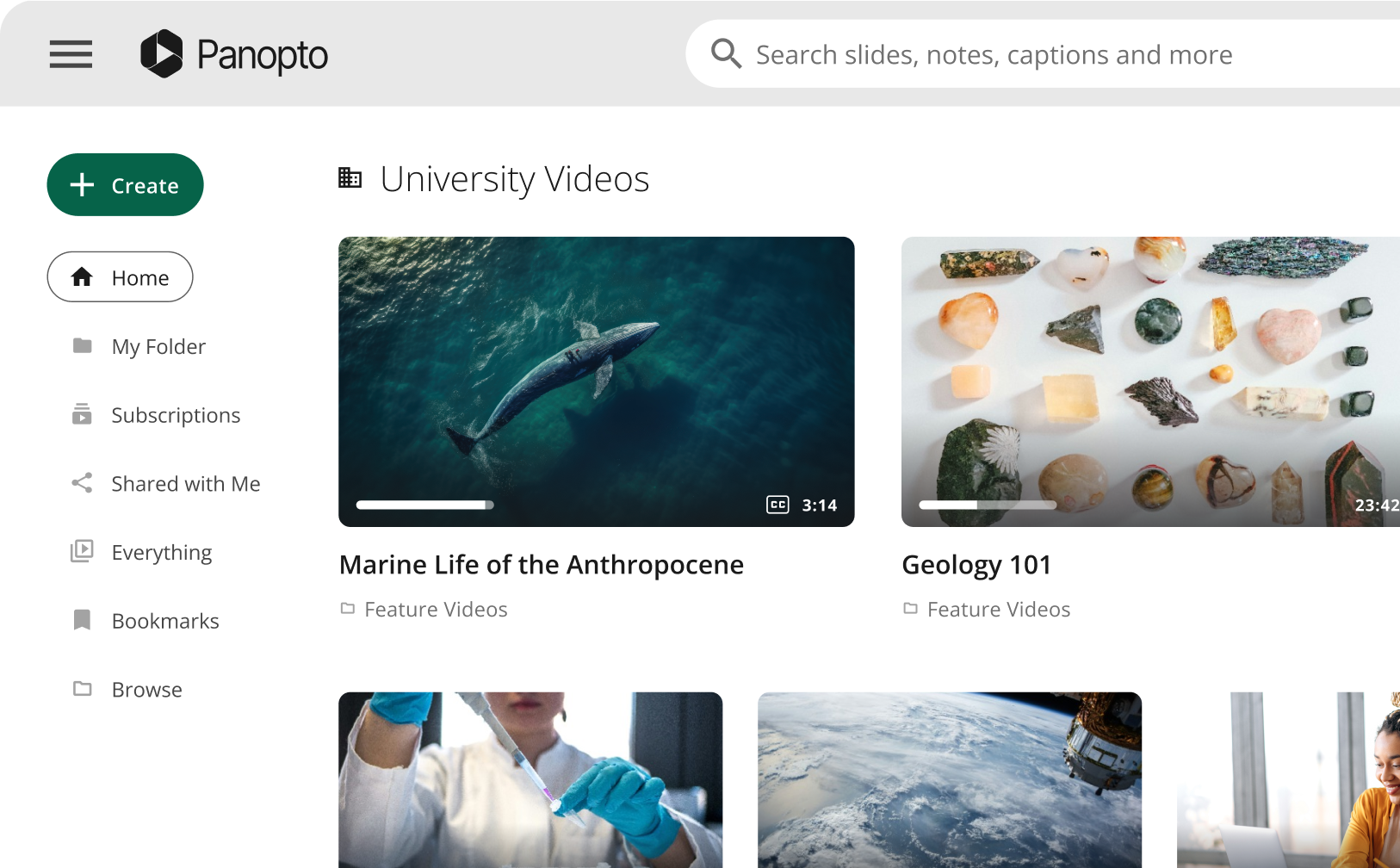
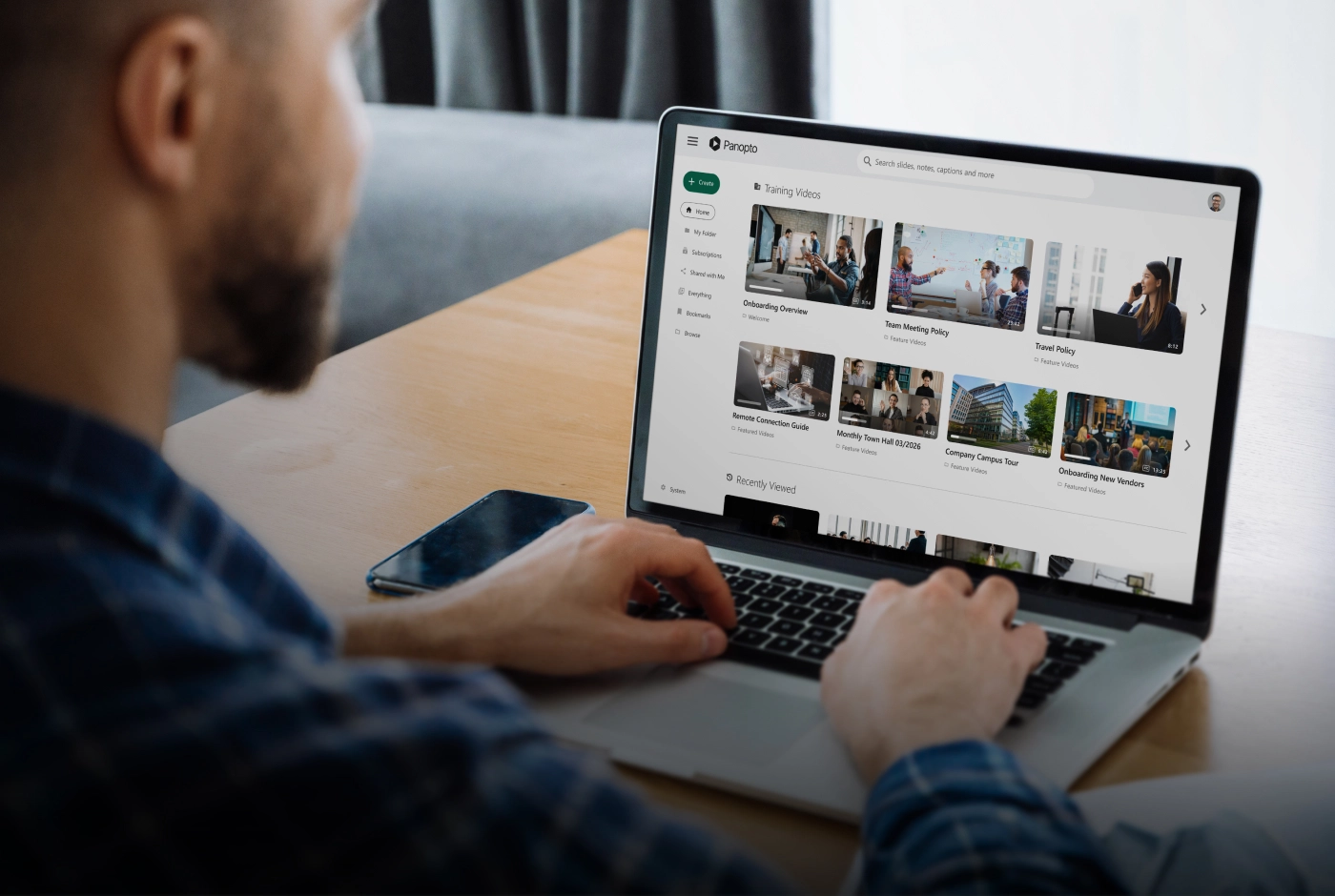
- Where the videos live afterward. Does the tool publish into a searchable, permissioned library, or does it hand you a file to put somewhere? A training video in a download folder is a training video nobody finds.
- Analytics. Per-viewer watch time and completion, quiz results, and passback to your LMS, so compliance training has a record.
- Security. Single sign-on, role-based access, data handling you can show your security team, and a clear statement of whether your content is used to train the vendor’s models.
The items near the bottom of the list are the ones vendors talk about least and the ones that decide whether the tool is still in use in a year.
Panopto’s AI Video Studio is built to clear the list as an add-on to the Panopto Video CMS: PowerPoint, PDF, text and prompt to video with speaker notes as narration, 500+ licensed avatars, 450+ voices across 75+ languages with voice cloning in 28, one-click translation that re-syncs narration and captions, 100+ templates with a brand kit, scene-level editing and re-rendering, quizzes and branching scenarios in the same editor, and publishing straight into the Panopto library, where the video is searchable and tracked from day one.
How to create a training video with AI, step by step
Step 1: Prepare the content
- Decide the one thing the video teaches.
- Then write for a listener, not a reader: short sentences, plain words, pronunciation notes for product names and technical terms, and the key point in the first thirty seconds.
- If the content already exists as a slide deck, add speaker notes; most AI tools turn them into the narration and each slide into a scene.
- Break anything longer than a few minutes into separate videos, each with its own title, so people can find the piece they need.
Step 2: Generate the video
- Start from your deck, document or prompt, or from a template.
- Pick the presenter format that fits the content: an avatar for a policy walkthrough, voiceover over slides for a process, a two-avatar dialogue for a scenario.
- Choose a voice your audience will listen to for five minutes.
- Apply the brand kit.
- Then watch the whole draft once, out loud, before anyone else does; mispronounced product names are the most common fix.
Step 3: Add the interactive elements
A knowledge check after each key point, a branching decision where the real job has one, chapters so viewers can jump to the part they need, and a short quiz at the end of anything that counts as compliance.
Add what serves the learning objective and nothing else.
Step 4: Tighten it for attention and access
Shorter is better.
In a study of 6.9 million video-watching sessions in edX courses, median engagement fell as videos got longer and stayed at or under about six minutes regardless of length.
A few other accessibility items:
- Captions on by default
- Translations for every language the audience speaks
- Text large enough for a phone
- Examples from your organization rather than generic ones.
Step 5: Publish it where it will be found, and measure it
Publish into the library, not a download folder. Assign it in the LMS if it is required.
Then read the analytics: where viewers drop off, which chapters get rewatched, quiz results by question, completion by team. A video everyone abandons at minute four is too long or answers the question too late.
When the content changes, edit the scene and re-render it; the link, the LMS assignment and the translations update with it.
Keeping AI training videos current
Assign an owner to each video. When the policy or the product changes, the owner edits the affected scene’s script and re-renders that scene; the rest of the video, its link and its translations stay as they were.
Review the analytics quarterly for videos people search for and cannot find, and videos they start and do not finish. Those two lists are the roadmap.
Put AI video to work in your training library
AI makes the standard training video cheap to make and cheap to update. Your experts make the hands-on video nothing else can. A searchable, tracked library makes both findable.
See how Panopto’s AI Video Studio fits into video training at your organization. Request a demo to see a slide deck turned into a tracked, translated training video in your library.
Frequently asked questions
Yes. AI video tools build a narrated, avatar-presented training video from a slide deck, a document, a script or a text prompt, with captions, chapters and translations generated at the same time. The result works best for content that lives in words (policies, processes, onboarding basics) and is updated by editing the script rather than re-recording.
Are AI avatar videos good enough for training?
Yes, for policy, process and knowledge content: the video is consistent, available in every language and updated in minutes. For hands-on skills, a recording of a real expert doing the task teaches better and carries more credibility. Most programs use AI for the standard layer and recorded experts for the demonstrations.
How long does it take to make an AI training video?
Minutes for the generation step, once the deck or script is ready. Preparing the content, adding knowledge checks and reviewing the draft take longer than rendering it. A policy update that used to be a new recording session becomes an edit to one scene.
Can AI training videos be made in other languages?
Yes. Tools such as AI Video Studio translate the script, re-sync the narration and update the captions in 75+ languages from one source video, so a workforce that speaks several languages gets the same training without a separate recording for each.
How do you keep AI training videos up to date?
Give each video an owner, keep it in a library where the link stays stable, and edit the affected scene when content changes rather than rebuilding the video. Use the viewing and quiz data to find the videos people search for and cannot find, or start and abandon, and fix those first.