

- Higher Education
A Roundup of AI Implementation Policies in Higher Education

Universities are facing a challenge straight out of science fiction: how to deal with AI in education. AI tools hold incredible potential—think personalized lessons, automated feedback, and learning that’s more accessible than ever.
But this new frontier also brings up big questions. How does a learning institution maintain academic integrity when students ask a bot to write their essays? How do universities ensure AI is used ethically? And what’s the role of educators in this evolving landscape?
Policies regarding AI in education
Integrating AI into higher education is a complicated endeavor. Think about it. Professors suddenly have to become AI experts, figuring out if that essay is a student’s original work or something whipped up by a chatbot. No wonder 81% of university presidents admitted in early 2024 that they hadn’t yet nailed down their AI policies. Interestingly, in 2023, 99% of school leaders believed AI would be key to driving competitiveness in the future. The change has been thoughtful but slow.
But there is good news. The initial panic after ChatGPT hit the scene is fading. Universities are getting a handle on things. They’re realizing AI isn’t just a threat to academic integrity but a powerful tool that can actually improve teaching and learning.
The policies being developed and implemented can be divided into two major categories: academic integrity and pedagogical integration.
Academic integrity
Regarding AI in higher education, institutions’ policies focus heavily on academic integrity. The policies typically state that students would violate the institution’s honor code if they used an AI large language model or similar tool to draft their classwork. And it’s not just about whole essays.
Even rewording something you got from an AI tool like ChatGPT or Gemini is a no-go. At some schools, this prohibition is a default, allowing individual professors to deviate from the rules if they wish.
University leaders are implementing these policies to ensure students are actually learning and developing essential critical thinking skills. They want students to grapple with the material, form their own arguments, and do the hard work of writing. The result is that the student’s degree will genuinely reflect their knowledge and abilities, not just the skills of a fancy algorithm.
Teaching with AI in Higher Education
Now, here’s where things get interesting. Some universities are realizing that AI in higher education isn’t just something to be policed. They want AI to be a vital part of learning in the 21st century! To achieve that objective, they’re stepping up and giving professors the tools they need to teach students about AI and the ethics involved with its use. In this decentralized model, professors develop their own individual policies that students must follow.
Many institutions consider AI to be a critical learning component in higher education. Recognizing this, some have provided teaching resources intended to help professors discuss AI with students and teach them about ethical use. The school may also inform students about privacy issues surrounding the use of AI, what tools exist, how to evaluate responses produced by an LLM, and even how to cite an AI response properly.
The evolving role of AI in education
AI in higher education is a journey, not a destination. While the initial uncertainty around AI is fading, universities are stepping up to the challenge. They’re creating policies that promote academic integrity while also exploring how AI can personalize learning, provide faster feedback, and even help design more engaging courses.
Tools like Panopto, with its AI-powered video search and accessibility features, are already playing a key role in this transformation. As AI evolves, ongoing adaptation and collaboration will be key to ensuring this powerful technology truly benefits everyone in higher education.
Have questions about AI in education using a video platform like Panopto? Contact us today.
Latest News
-
- Remote Work
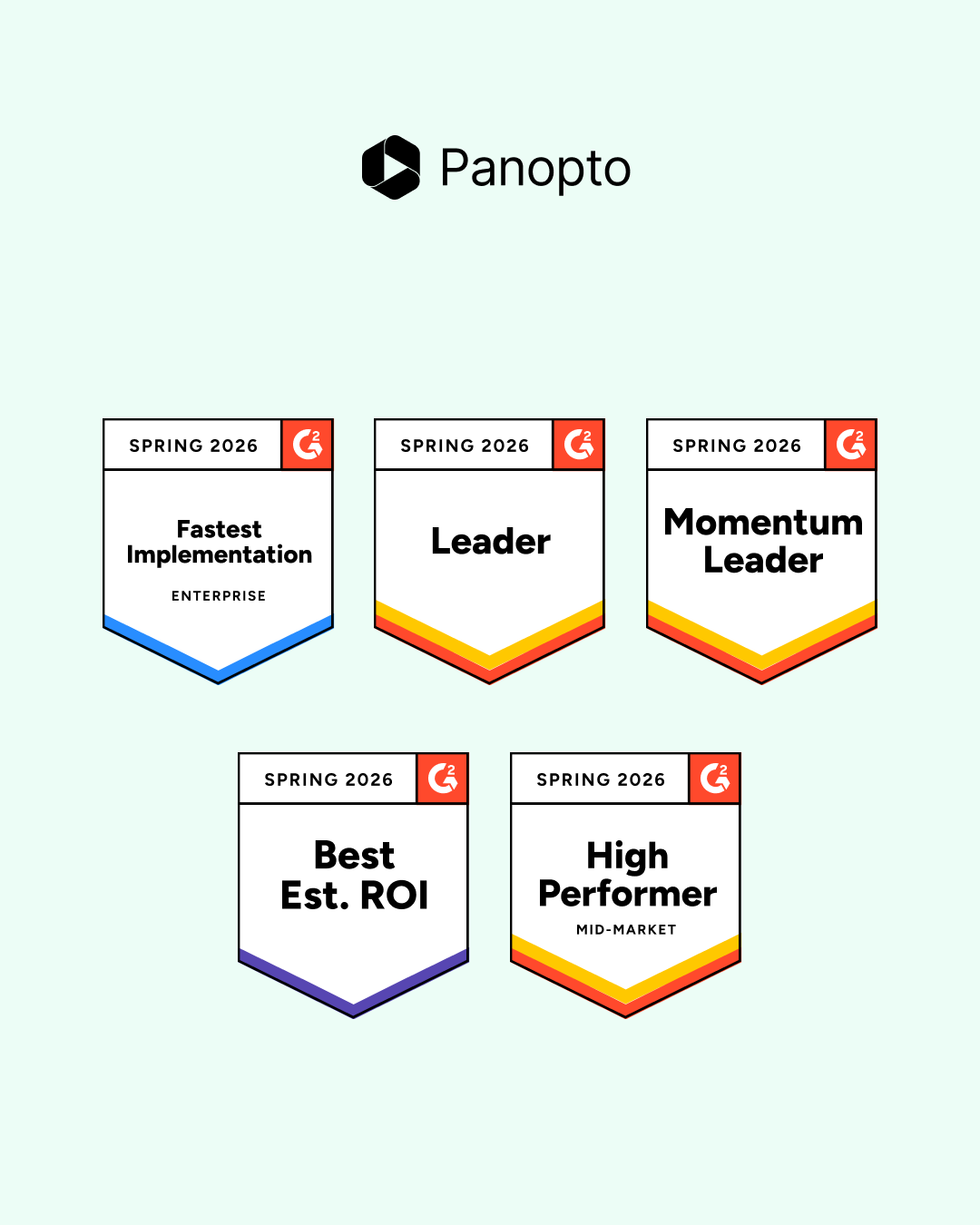
How Our Customers Made Panopto a G2 Spring 2026 Leader
We’re proud to support the customers whose feedback and real-world outcomes led to Panopto being recognized with multiple G2 Spring 2026 badges. This season, Panopto earned Leader, Momentum Leader, High Performer, Fastest Implementation, and Best Estimated ROI badges across multiple G2 Spring 2026 Reports, based on its performance within the Video Communications, Video CMS, Virtual…
How Our Customers Made Panopto a G2 Spring 2026 Leader
-

- Enterprise Video Platform
Best Video Management Platforms for Training and L&D Teams in 2026
Most video platforms were built for marketing teams. They track clicks, conversions, and ad performance. That’s useful if you’re selling a product. It’s not useful if you’re training 5,000 employees on updated compliance procedures and need to know who actually watched the whole thing. Training teams have a different set of problems to solve. You…
Best Video Management Platforms for Training and L&D Teams in 2026
-

- Webinar Recap
Beyond the Prompt: Key Webinar Insights on AI as a Strategic Thought Partner
The landscape of Artificial Intelligence in Learning and Development has reached a critical tipping point. It is no longer a question of whether organizations are introducing these tools, especially as AI adoption jumped from 55% to 78% in the last year alone. Instead, the focus has shifted to whether they are using it to move…
Beyond the Prompt: Key Webinar Insights on AI as a Strategic Thought Partner