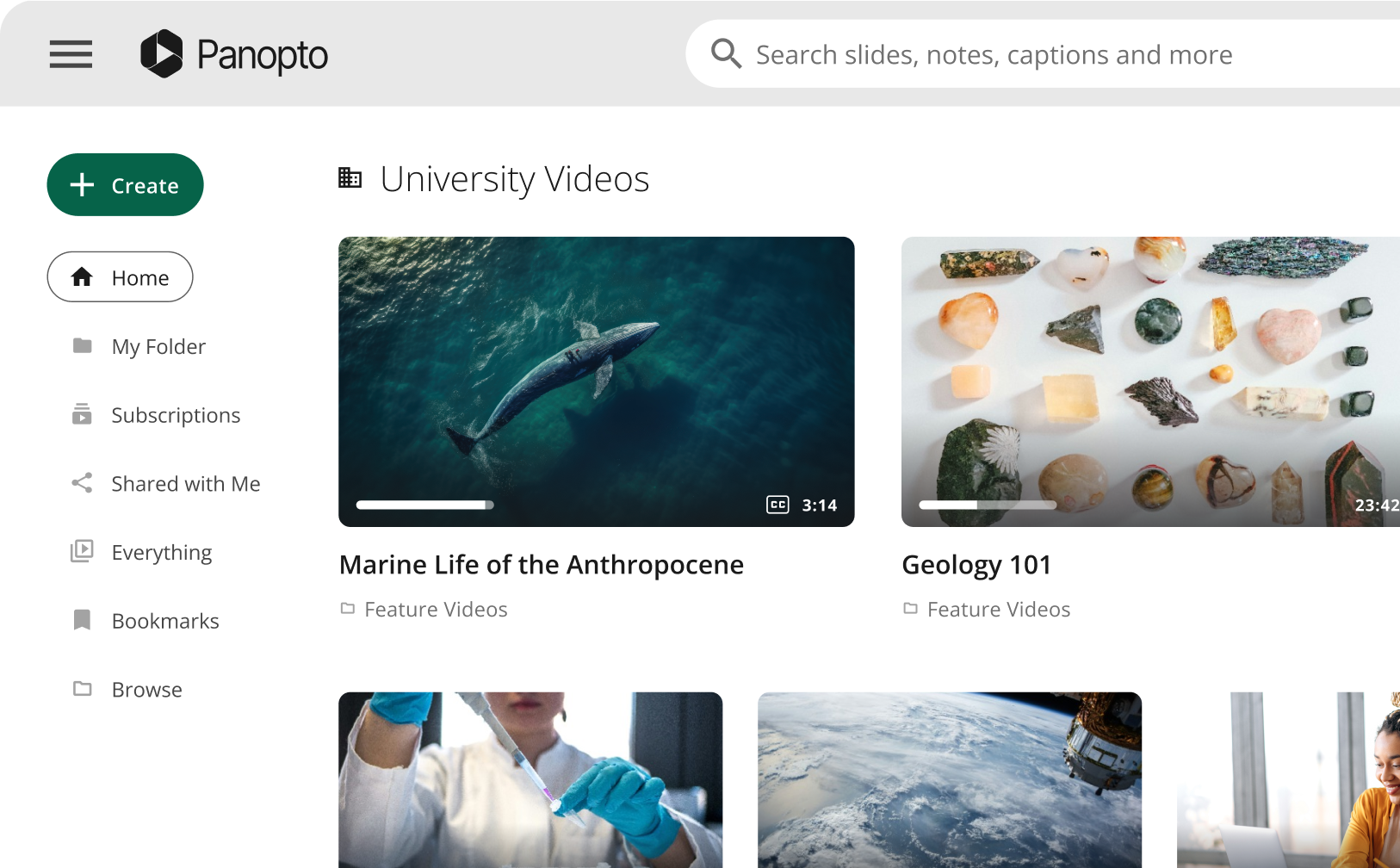









Opencast and Panopto both capture and share lecture video but differ in who runs the system. Opencast is free, open-source software that an institution installs, hosts, and maintains itself or pays a partner to host. Panopto is a managed cloud platform with search across spoken and on-screen words, analytics for each viewer, learning management system (LMS) integrations, and certified security. Panopto also operates the servers for cloud customers. The choice often depends on in-house engineering capacity and hosting location.
This comparison draws on Opencast’s and Panopto’s own documentation, reviewed in November 2026.
Comparison at a glance
| Area | Panopto | Opencast |
| Model | Managed SaaS cloud service run by Panopto, or an on-premises deployment | Open source (ECL 2.0), hosted by the institution or by a partner |
| Cost | Licensed by custom quote | Free software, with servers, staff, or a hosting partner as added costs |
| Capture | Classroom, desktop, browser, and mobile recording, plus certified hardware | Scheduled capture, Opencast Studio in the browser, and hardware from listed vendors |
| Search | Spoken words, on-screen text, and slide content | Portal search through Tobira, including subtitles and slide text |
| Integrations | Canvas, Blackboard, D2L Brightspace, Moodle, Microsoft Teams, and Zoom | LTI, plugins for Moodle, ILIAS, and Stud.IP, and user providers for Canvas, Brightspace, and Sakai |
| Security | SOC 2 Type II and ISO 27001, 27017, 27018, and 9001 certifications, FERPA, GDPR | Depends on the host |
| Support | Vendor support | Community support, or a paid hosting partner |
Team fit
Opencast fits institutions with a media engineering team that wants full control of the stack and institutions that must host video on their own infrastructure.
Panopto fits institutions that want lecture capture and a searchable video library without running servers, want a vendor to provide support, or serve corporate and continuing education audiences from the same platform. Panopto for higher education covers lecture capture, hybrid learning, and active learning.
Total cost of ownership
Opencast software costs nothing to license, and running it costs infrastructure and people. Opencast’s administration guide describes the single-node all-in-one installation as suitable for testing and usually unsuitable for production. It lists a two-server setup, which separates video processing from the rest of the system, as the minimum recommended for production, and it describes setups with three or more servers and dedicated worker nodes for added capacity. The guide also recommends shared storage over NFS.
Institutions that prefer not to run servers can use a hosting partner, and Opencast’s hosting page lists ELAN e.V., shio solutions, and ssystems. Published prices give a starting point. As of November 2026, ELAN e.V. lists Opencast cloud hosting from €17,749 a year and on-premises hosting from €19,999 a year, with LMS integration, migration, and automatic subtitles as optional extras. It describes the package as optimized for small and medium-sized universities.
Panopto is licensed and quoted per organization. Panopto’s pricing page says each quote reflects the number of users, integrations, add-ons, and deployment model. A fair comparison adds up license or hosting fees, servers, storage, staff time, captioning, and support for each option.
Capture and recording
Opencast schedules recordings and live streams from its admin interface. Users can record in a browser with Opencast Studio. Users can also use capture agents that upload recordings automatically. It also includes a browser-based video editor. Opencast’s hardware page lists Arec, Epiphan, Extron Electronics, Matrox, and Teltek.
Panopto records in classrooms, on desktops, in browsers, and on mobile devices, and Panopto Express offers free browser recording. Panopto’s list of certified capture hardware includes Epiphan, Extron, Lumens, and Wolfvision appliances, and Panopto endorses Magewell capture devices.
Both vendors list Epiphan Pearl hardware, so existing rooms may not need new hardware with either platform, though compatibility depends on the specific device.
Search and accessibility
Panopto indexes spoken words with automatic speech recognition (ASR), on-screen text with optical character recognition (OCR), and slide content, including speaker notes. Results carry timestamps across a library, so a student goes straight to the moment a term appears. Panopto supports automatic captions in more than 20 languages and indexes translated captions for search. Panopto’s Accessibility Conformance Report documents conformance with WCAG 2.2 Level AA and Section 508, and the report is available through the Panopto Trust Center.
Opencast includes local automated transcription with Whisper and works with third-party transcription services. Its Tobira video portal can search subtitles and slide text, so recordings that have subtitles can be found by their spoken content as well as their metadata.
Integrations
Opencast connects to any LMS that supports LTI. It offers plugins for Moodle, ILIAS, and Stud.IP and user providers for Canvas, Brightspace, and Sakai, where user providers bring LMS roles into Opencast and plugins add Opencast functions inside the LMS. It also integrates with Zoom and BigBlueButton recordings and with Matomo analytics.
Panopto integrates with Canvas, Blackboard, D2L Brightspace, and Moodle, and it lists Cornerstone and Bridge for corporate learning systems. The Moodle integration combines LTI 1.3 with a plugin and syncs roles and course folders. Panopto Cloud also imports Microsoft Teams and Zoom recordings, and Panopto lists Webex and Slack integrations and supports single sign-on (SSO) through SAML 2.0, Active Directory, and OAuth 2.0.
Analytics
Panopto reports watch time and percent completed for each viewer, how each viewer accessed the content, and engagement heatmaps, and quiz analytics report results for individuals and groups. Quiz scores and completion data flow to the LMS gradebook for Canvas, Blackboard, and D2L Brightspace where grade passback is configured, and reports can be exported.
Opencast gathers viewing metrics through the Paella player and its Matomo integration.
Security, hosting, and data residency
Panopto holds a SOC 2 Type II attestation, ISO 27001, 27017, 27018, and 9001 certifications, and TX-RAMP Level 2 certification. Panopto supports compliance with GDPR and FERPA and participates in the EU-US, UK, and Swiss Data Privacy Frameworks.
Opencast is software, so certifications depend on who hosts it. ELAN e.V. states that its hosting runs on GDPR-compliant servers that are ISO 27001 certified.
Data residency is a separate question. Panopto Cloud runs on Amazon Web Services with server options in the United States, Canada, the European Union, Southeast Asia, and Australia, and Panopto added Japan-based hosting in June 2024. Panopto, Inc. is a U.S. company, and Panopto also offers an on-premises deployment option for institutions that host the platform themselves. Institutions with a policy that requires infrastructure under their own legal control can also run Opencast on their own servers or with a hosting partner such as ELAN e.V., which uses a German university data center.
Support and roadmap
Opencast offers community support and paid support from hosting and software partners. The project releases twice a year. In December 2025, the Opencast board announced that it resolved to move the project’s institutional home from the Apereo Foundation to Linux Foundation Europe.
Panopto provides vendor support. In Fall 2026, Panopto announced three AI capabilities: Panopto Folio, AI Search, and Panopto MCP Server. AI Search answers questions across a library and links to the source clip and timestamp; Folio generates study guides, flashcards, and practice quizzes from library content; and MCP Server connects Panopto knowledge to approved tools such as Claude, ChatGPT, and Microsoft 365 Copilot with read-only access.
Frequently asked questions
Is Opencast free?
Opencast software is free to license under the Educational Community License 2.0. Running it takes servers, storage, and staff time, or a hosting partner.
What is the difference between Panopto and Opencast?
Opencast is open-source software that an institution hosts itself or through a partner, and Panopto is a managed cloud platform that Panopto operates, with an on-premises option. Opencast offers community support and paid partners, and Panopto offers vendor support. Panopto indexes spoken words and on-screen text automatically and reports analytics for each viewer.
Does Opencast integrate with Canvas or Moodle?
Yes. Opencast offers plugins for Moodle, a user provider for Canvas, and support for any LMS that uses LTI. User providers bring LMS roles into Opencast, while plugins add Opencast functions inside the LMS.
Can Panopto host video in the EU?
Yes. Panopto Cloud offers a server region in the European Union, alongside regions in the United States, Canada, Southeast Asia, and Australia, and Panopto added Japan-based hosting in June 2024. Panopto’s security page also lists participation in the EU-US, UK, and Swiss Data Privacy Frameworks.
Can institutions keep their capture hardware if they switch?
It depends on the device. Both Panopto and Opencast list Epiphan Pearl hardware, so rooms with those units may keep them. Panopto publishes a list of certified hardware, and Opencast lists vendors including Arec, Epiphan, Extron Electronics, Matrox, and Teltek.
How do Panopto and Opencast compare on accessibility compliance?
Panopto’s Accessibility Conformance Report documents conformance with WCAG 2.2 Level AA and Section 508, and Panopto offers automatic captions in more than 20 languages and human-transcribed captions as a paid service. Opencast’s documentation describes accessibility work on Opencast Studio and the Paella player, and the conformance level of an Opencast site depends on its version, configuration, and host. Institutions can request conformance documentation from Panopto and from any Opencast host.
What is a managed alternative to Opencast?
Panopto is a managed alternative to Opencast for institutions that prefer a vendor to run the platform. Panopto offers lecture capture, a searchable video library, LMS integrations, and vendor support.