









The best video training solutions for manufacturing
Manufacturing video training software falls into four distinct categories:
- Enterprise video platforms for capturing expert knowledge across an entire organization
- Connected-worker platforms for floor-level work instructions and skills tracking
- Learning management systems for structured courses and compliance records
- Industrial content libraries for ready-made certified courseware
The right fit depends on a few factors. Is the manufacturer creating original training content or using prebuilt material? Is the audience the plant floor alone or the whole company?
Manufacturers need consistent, repeatable training that reaches a distributed, often deskless workforce across multiple sites and time zones.
In fact, that search leads to a crowded field. A query for the best video training solution for manufacturing returns results spanning several different types of software. Results range from platforms built to capture veteran operators’ knowledge to systems built for compliance recordkeeping.
Choosing based on brand recognition or a persuasive demo can lead a manufacturer toward the wrong category entirely. The products that surface first in a search are not always the ones built for the specific problem at hand.
Two questions can help identify the best video training solutions for manufacturing. First, do you want to create original training content from in-house experts, or rely on prebuilt material? Second, is the audience only operators on the plant floor or employees across the whole organization? Those answers determine which category fits best.
What does a manufacturing video training solution do?
The best manufacturing training software replaces static paper procedures and PDFs with video content operators canwatch and retain. It gives teams a practical way to capture the tribal knowledge of experienced workers, including those with no video production background. That expertise gets captured before it leaves with them at retirement.
In particular, findability may be the most valuable capability. Ideally, an operator troubleshooting a jam can search directly to the relevant thirty seconds of a procedure instead of scrubbing through an hour of footage. This capability frequently determines whether a training library actually gets used.
The strongest solutions also standardize instruction across multiple sites and languages. Version control retires outdated procedures when processes change, and quizzes and completion records can verify comprehension.
For a distributed, often deskless workforce, delivery matters as much as content. Mobile and tablet access, along with reliable performance in low-connectivity environments, determines whether training actually reaches the floor.
Role-based assignment, a full audit trail, and reporting beyond raw completion rates give safety and compliance teams the documentation that regulated manufacturers depend on. That reporting should cover measures like time to competency and engagement.
Security matters just as much. A platform handling proprietary process video for a global manufacturer warrants the same rigor applied to any other enterprise system of record, like an LMS, HRIS, or SharePoint.
The four categories of manufacturing video training software
The tools that surface when searching for the best video training solution for manufacturing come from four categories built for entirely different jobs. Understanding which category matches your actual need leads to a much better decision than shopping by name recognition alone.
Enterprise video platforms
What it is: A platform to capture, host, manage, search, and analyze video across the organization. Native training features, including interactive quizzes, completion tracking, and viewer analytics, live directly inside the platform.
Best for: Capturing in-house expert knowledge and building one searchable library that serves training, corporate communication, and onboarding across every function and site, from the plant floor to the corporate office.
Representative players: Panopto, Kaltura, YuJa, and Vimeo’s enterprise tier anchor this category, each built around video that stays searchable and reusable across every part of a business.
Trade-offs: Real-time skills matrices tied to active machinery and guided task validation during a live procedure are more present in connected-worker platforms (covered below), which many manufacturers pair with an enterprise video platform rather than choose between.
Choose this if: This category fits manufacturers whose knowledge lives primarily in their own experts and who want one video platform for the whole company, with searchability across a large library as a priority.
Connected-worker platforms
What it is: Frontline operations software built outward from the machinery and workstation itself. They combines digital work instructions, a skills matrix tied to specific equipment, competency tracking by line and shift, and issue logging that surfaces problems as they happen.
Best for: Floor-level, in-the-flow-of-work training and standard work, including instruction accessed by scanning a code directly at the machine.
Representative players: Poka and Dozuki anchor this category. Tulip and Augmentir offer no-code app-building and AI-driven skills intelligence. DeepHow adds AI-generated video work instructions with built-in task validation that checks an operator’s execution against an approved procedure.
Trade-offs: The category’s strength on the floor comes at the cost of a narrower scope elsewhere. These platforms serve as the primary system for operations, while company-wide communication and onboarding across functions outside operations typically run through other tools.
Choose this if: This category fits manufacturers whose primary need is operator work instructions, a live skills matrix tied to specific equipment, and competency tracking on the line.
Learning management systems
What it is: General corporate learning platforms that manage courses, learning paths, completions, and certification records across an organization, with video as one content type among several that a course can include.
Best for: Structured course delivery, compliance and certification recordkeeping, and enterprise-wide learning administration.
Representative players: 360Learning, Docebo, TalentLMS, Litmos, and Cornerstone represent this category, each built around managing training programs and their records at scale.
Trade-offs: An LMS’s administrative strength often comes with weaker video capabilities. Quick SME video capture and in-video search typically favor platforms purpose-built for video, and floor-level delivery quality varies by vendor and edition.
Choose this if: This category fits manufacturers that need a formal system of record for course completions and regulatory compliance, with video as part of a broader curriculum.
Industrial content libraries
What it is: Prebuilt, off-the-shelf manufacturing courseware, often mapped to credentials, sometimes delivered through VR simulation.
Best for: Standardized, certified curricula that manufacturers consume rather than create, covering topics like machine operation basics, safety, and compliance.
Representative players: Tooling U-SME maps its catalog to credentials from bodies including MSSC and NIMS. Vector Solutions covers safety and compliance topics across industrial settings, and Transfr uses VR simulation to build hands-on skills aligned with standards like MSSC and ASME.
Trade-offs: Ready-made content offers convenience but limits customization. Generic courseware reflects industry standards rather than a specific plant’s equipment, processes, or safety culture, a limitation that comes up often in discovery conversations.
Choose this if: This category fits manufacturers who want certified training fast, without customizing it to their own plant.
At a glance: How the four categories compare
| Category | Best for | Create or consume content | Solution providers |
| Enterprise video platforms | Capturing SME knowledge and building one searchable library across the whole company | Create | Panopto, Kaltura, YuJa, Vimeo (enterprise) |
| Connected-worker platforms | Floor-level work instructions and skills tracking tied to equipment | Create | Poka, Dozuki, Tulip, Augmentir, DeepHow |
| Learning management systems | Structured courses, completions, and compliance records | Both | 360Learning, Docebo, TalentLMS, Litmos, Cornerstone |
| Industrial content libraries | Standardized, certified curricula | Consume | Tooling U-SME, Vector Solutions, Transfr |
When an enterprise video platform like Panopto makes sense
A connected-worker platform delivers deep, purpose-built functionality for the plant floor. An enterprise video platform like Panopto delivers built-in recording, quizzes, completion tracking, and analytics alongside one video system that the entire organization can use for training, onboarding, corporate communication, and knowledge sharing.
First, the advantage starts with knowledge capture. Panopto lets subject matter experts record peer-to-peer training on any device or in a web browser, with no prior video experience. The expertise that would otherwise leave with a retiring operator becomes a searchable asset the whole company can draw on.
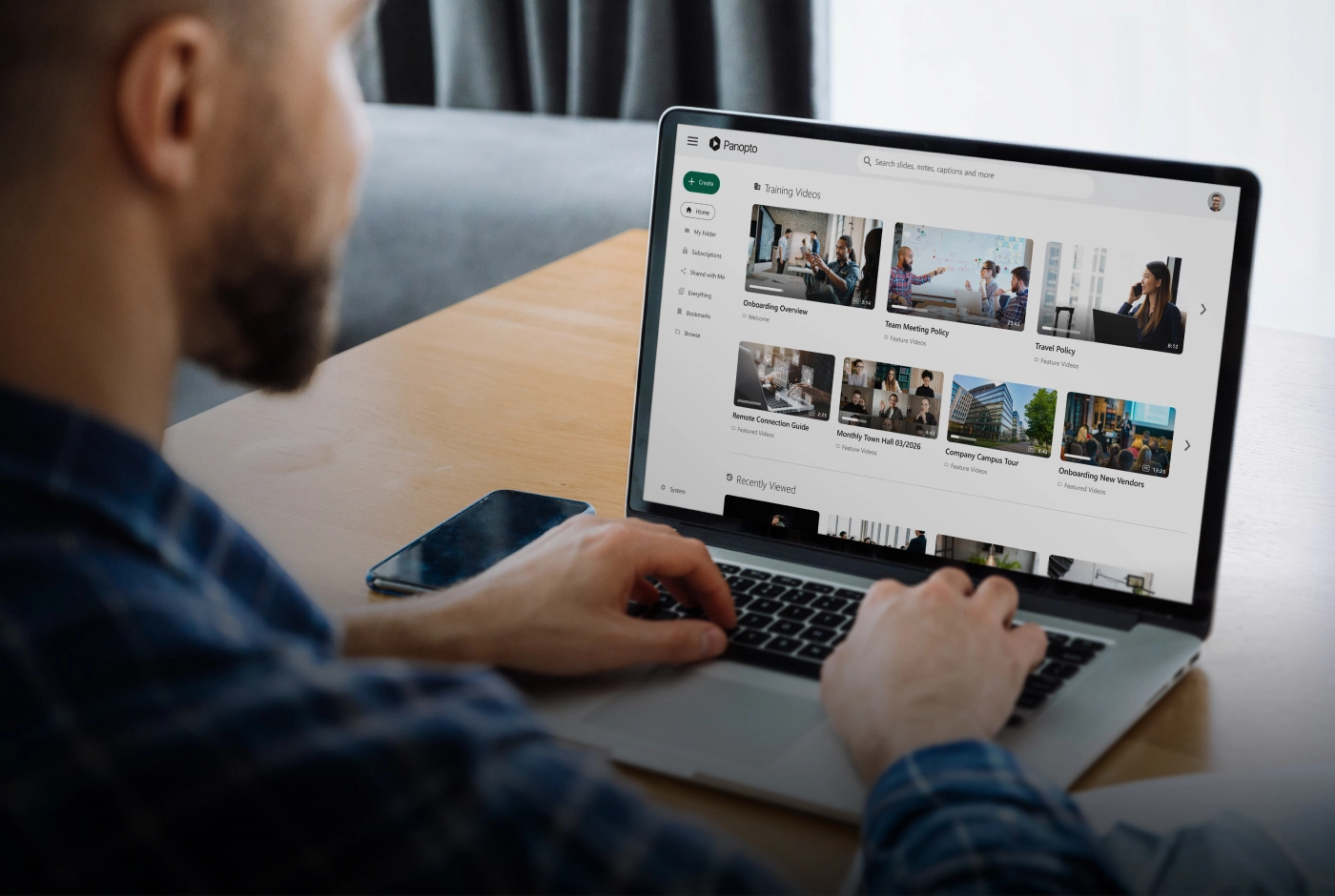
Many buyers file platforms like Panopto under video hosting, missing the training capability built into the product. Interactive quizzes and completion tracking come built into the platform, and viewer analytics show learning and safety teams whether training is landing with employees.
Smart search lets an operator locate the exact moment of a procedure instead of scrubbing through an entire recording. That single capability is often the difference between a knowledge base used daily and one that quietly falls out of rotation.
Beyond that, an enterprise video platform offers a broader scope than a floor-only connected-worker platform. A single, permissioned video library can support training on the plant floor and onboarding for new hires across the company. It also carries corporate communications from leadership and knowledge sharing across every division and site, all searchable from the same system.
Version control keeps that library current. When a procedure changes, the outdated video drops out of circulation. Standardized, multilingual content lets manufacturers deliver consistent training across sites and languages.
Where a connected-worker platform wins
A machinery-linked skills matrix or real-time task validation on the line calls for a connected-worker platform first. In that situation, an enterprise video platform like Panopto works alongside it as the knowledge and training layer, complementing the floor system already in place rather than competing with it.
That complementary relationship, and the reach a platform like Panopto provides across an entire organization, is clear in how Sanmina built its training and communication strategy across twenty countries.
How Sanmina built one video platform for a 20-country manufacturing footprint
Sanmina designs and manufactures electronic, optical, and electromechanical products. The organization serves customers across communications, cloud infrastructure, industrial, medical, automotive, and defense and aerospace sectors, with operations across twenty manufacturing countries.
Maintaining their position as a trusted partner depends on fluid knowledge exchange across a globally distributed workforce. That need led Sanmina to look for a fully featured video platform for both training and internal communication.
Sanmina selected Panopto and migrated its entire video library off a legacy platform within a few weeks. Mario Zuniga, IT Director of Digital Workplace at Sanmina, found the new platform faster and more capable than what it replaced.
The company’s internal subject matter experts, including many with no prior video experience, now record peer-to-peer training directly in a web browser from any device. Cloud-based training extends access to viewers wherever they are located, from a Sanmina facility to a home office.

The impact reached beyond the training team. Smart Chapters, Panopto’s in-video search feature, became a favorite among employees for digesting information quickly.
Sanmina’s Defense and Aerospace division adopted the platform for monthly and quarterly internal communication, utilizing viewer analytics to gauge how messages were landing and to plan the timing of future updates.
Across the company, training video views doubled, and creators gained the ability to limit access by team while tracking viewership through built-in reporting.
The result reinforces the whole-organization thesis described above, proven at the scale of a twenty-country manufacturing footprint: the right video platform can serve training and cross-division communication at once.
Frequently asked questions
The best video training software for manufacturing depends on what a plant needs to accomplish. Tools that appear under this search term span four distinct categories built for different jobs, so the right answer depends on the use case.
Enterprise video platforms such as Panopto, Kaltura, and YuJa focus on capturing expert knowledge and building one searchable library for training and communication across an entire organization. Connected-worker platforms such as Poka, Dozuki, and DeepHow focus on floor-level work instructions and equipment-linked skills tracking. Learning management systems such as Docebo and 360Learning manage courses and compliance records, with video as one content type among several. Industrial content libraries such as Tooling U-SME and Vector Solutions supply ready-made, certified courseware for manufacturers who want standardized training without building their own. Matching the category to the actual need matters more than comparing brand names.
An LMS and a video platform serve different purposes. The better fit depends on whether a manufacturer needs a system of record for completions and compliance or a system built to capture and search video content.
A learning management system excels at administering formal programs, tracking course completions, and producing compliance documentation across the organization. A video platform like Panopto excels at capturing expert knowledge on video, making any moment inside that footage searchable, and analyzing viewer engagement. Many manufacturers run both together: the LMS handles assignment and reporting, while the video platform handles how content gets created, found, and consumed on the floor.
The choice depends on your priorities. A connected-worker platform fits floor execution and equipment-linked skills tracking. A video platform fits whole-organization knowledge capture and training. Many manufacturers use both together.
Poka and similar connected-worker platforms tie directly into machinery and workstations, running a live skills matrix and guided task validation at the point of work. Panopto and similar video platforms extend beyond the floor, giving a manufacturer one searchable library for training, onboarding, and communication across every function and site. Many large manufacturers run a connected-worker platform for floor execution alongside an enterprise video platform for broader knowledge capture and distribution.
Manufacturers capture SME knowledge by having experienced operators record procedures and demonstrations directly on video, often through browser-based tools that require no prior production experience.
At Sanmina, subject matter experts across the company, including many who had never created video before, record peer-to-peer training in a web browser using Panopto’s built-in screen recorder. They capture walkthroughs and demonstrations without a dedicated production team. That approach turns tribal knowledge, otherwise at risk of leaving with a retiring employee, into a searchable, reusable asset available to every shift and site.
Yes. Video training platforms that include interactive quizzes and completion tracking can verify that content was watched and, through embedded questions, whether the material was understood.
Completion data confirms that someone opened a video. Embedded quizzes add a layer of comprehension verification, and viewer analytics show how much of a video someone actually watched. Together, these capabilities give safety and compliance teams documentation to support audits, and they describe training capability rather than a guarantee of regulatory sign-off.
Yes. Modern video training platforms support mobile and any-device access, searchable content libraries, and multilingual delivery, all of which matter for a deskless, distributed workforce.
A workforce spread across shifts, sites, and countries needs training that reaches people wherever they are working. Mobile and tablet access lets operators reach training content on the floor, and searchable libraries help the right procedure surface quickly. Multilingual caption support removes language as a barrier to understanding safety and process instructions. Panopto, for example, supports captioning across more than twenty languages, which is part of how manufacturers with global operations standardize training across sites where employees speak different languages.
See how Panopto fits your training strategy
Choosing the right video training solution starts with knowing which of the four categories actually matches a manufacturer’s goals.
For organizations that need to capture expert knowledge, standardize training across sites, and build one searchable video library the whole company can use, Panopto is built for exactly that job. See a demo to find out how Panopto fits a specific training strategy and where it makes sense alongside the floor-level tools already in place.