
E-learning for Healthcare Guide

E-learning for healthcare has revolutionized medical education. Educators are no longer relying solely on classroom training and printed materials. Healthcare organizations face intense pressure to deliver quality training with limited resources. Now, e-learning offers the perfect solution. It transforms how medical professionals stay current with evolving knowledge and practices that save lives.
The strategic implementation of e-learning for healthcare platforms gives organizations a competitive edge. Staff remain competent and confident, and training outcomes improve while costs decrease. Whether you’re an administrator, educator, or practitioner, effective e-learning dramatically enhances educational results by reducing both costs and administrative burdens.
The Evolution of E-learning in Healthcare Education
The journey of e-learning for healthcare began with simple CD-ROMs and basic computer training in the 1990s. Traditional medical education once relied exclusively on textbooks and lectures, but the Internet changed everything. What started as supplementary has become essential.
Today’s healthcare e-learning platforms offer immersive simulations, interactive case studies, and adaptive learning paths. Modern medical students learn anatomy through 3D visualizations and practice diagnostic skills via virtual patient encounters. The COVID-19 pandemic only accelerated this digital transformation.
According to recent data, the global digital healthcare education market was valued at USD 49.45 billion in 2023 and is projected to reach USD 94.28 billion by 2030, growing at a compound annual growth rate (CAGR) of 8.4%. Healthcare organizations implementing digital learning solutions have seen measurable benefits, with healthcare facilities saving up to $5 billion annually with digital system adoption.
With adoption rates steadily increasing, e-learning for healthcare represents one of the most significant advances in medical education this century.
Key Benefits of E-learning for Healthcare Professionals
E-learning for healthcare delivers significant advantages over traditional training methods. First, accessibility transforms how medical professionals learn. Staff can access training anytime, anywhere, eliminating scheduling conflicts and geographical barriers. This flexibility proves particularly valuable for rural healthcare providers.
Cost-effectiveness represents another crucial benefit. Healthcare e-learning platforms reduce training expenses by eliminating travel costs, facility fees, and printed materials. Organizations implementing digital training report substantial savings when compared to traditional methods, allowing the reallocation of resources to patient care.
The standardization of clinical training through e-learning ensures consistent knowledge delivery across an organization. Every learner receives identical information about procedures, protocols, and best practices, reducing dangerous variations in care delivery. This standardization directly impacts patient safety and outcomes.
Other benefits include:
- Enhanced knowledge retention through interactive content.
- Immediate feedback on performance through assessments.
- Ability to practice high-risk scenarios safely.
- Personalized learning paths based on individual needs.
- Streamlined compliance training management.
Implementing Effective Healthcare E-learning Solutions
To maximize the benefits of e-learning for healthcare, organizations must select platforms with robust features. The right solution should seamlessly integrate with existing systems and infrastructure.
Essential Features of Healthcare Training Platforms
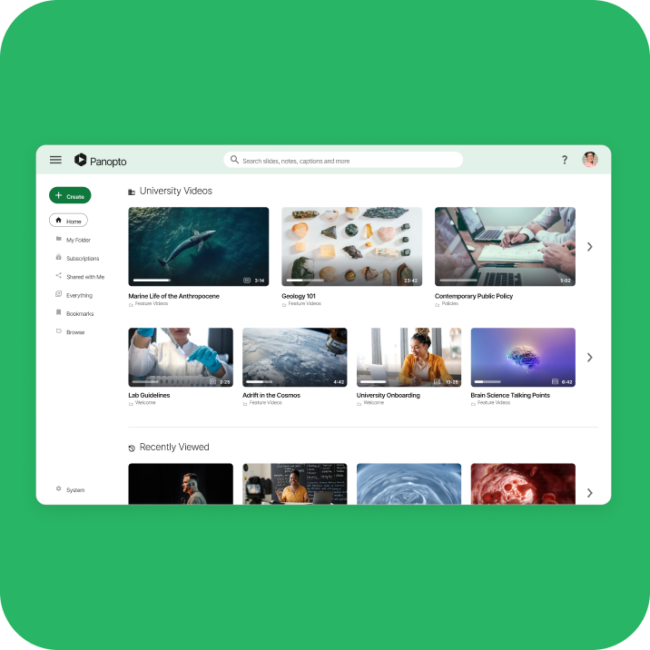
The most effective healthcare e-learning platforms include robust search functionality. Panopto’s video search technology lets professionals quickly locate specific content, whether searching for procedures, medications, or clinical scenarios, and find the right information in seconds. This feature proves invaluable during time-sensitive situations when immediate knowledge access impacts patient outcomes.
Creating Engaging Healthcare Video Content
Video-based learning has become central to e-learning for healthcare. High-quality clinical demonstrations, patient interaction scenarios, and procedural walkthroughs significantly outperform text-based instruction.
Consider these implementation strategies:
- Start with a content audit to identify critical training needs.
- Develop a consistent video production workflow.
- Incorporate interactive elements like quizzes and decision points.
- Include expert commentary alongside demonstrations.
- Implement tracking to measure completion and comprehension.
Building an on-demand repository of expert knowledge transforms how healthcare teams learn, creating continuous learning pathways that adapt to busy clinical schedules.
Future Trends in E-learning for Healthcare
The landscape of healthcare e-learning continues to evolve rapidly. Artificial intelligence and machine learning are revolutionizing medical education by creating adaptive learning experiences tailored to individual clinician needs. AI-powered platforms analyze performance, identify knowledge gaps, and automatically customize content, shifting from one-size-fits-all training to precision education.
Virtual and augmented reality represent another transformative trend in e-learning for healthcare. These technologies create immersive clinical simulations where professionals practice complex procedures without patient risk. Surgeons can rehearse operations, nurses can practice emergency responses, and teams can develop coordination skills in realistic virtual environments.
Personalized learning pathways are becoming standard in healthcare e-learning. These adaptive systems assess individual knowledge levels and learning preferences, then create customized educational journeys. This approach increases engagement while reducing time spent on already-mastered material.
Best Practices for Implementing Healthcare E-Learning
- Conduct thorough content audits: Begin by assessing existing training materials and identifying critical knowledge gaps. Map content to specific clinical competencies and regulatory requirements to ensure comprehensive coverage. This process should involve subject matter experts from various specialties to capture diverse perspectives.
- Develop consistent video production workflows: Establish standardized procedures for creating, reviewing, and publishing video content. Include clear guidelines for clinical demonstrations, lighting, audio quality, and presenter requirements. This consistency helps learners focus on content rather than adjusting to different presentation styles.
- Incorporate interactive assessments: Move beyond passive learning by embedding decision points, clinical scenarios, and knowledge checks throughout your content. These interactive elements promote active engagement and help reinforce critical concepts through practical application.
- Include expert commentary alongside demonstrations: Enhance procedural videos with insights from experienced practitioners explaining their decision-making process. This narrative layer transforms basic how-to content into powerful learning experiences that convey both technical skills and clinical reasoning.
- Implement robust analytics: Deploy comprehensive tracking to measure not just completion rates but also engagement patterns, knowledge retention, and on-the-job application. Use these insights to continuously refine your e-learning for healthcare programs based on actual performance data.
As these technologies mature, e-learning for healthcare will increasingly focus on measuring real-world clinical impacts rather than just completion rates or satisfaction scores.
Elevate Your Healthcare Training with E-learning Solutions
The transformation of healthcare education through e-learning represents a pivotal shift in how medical knowledge is acquired, shared, and applied. The benefits extend far beyond convenience, touching every aspect of healthcare delivery from cost reduction to standardized care practices.
Organizations implementing digital training gain competitive advantages through better-trained staff, consistent care delivery, and more efficient knowledge management systems.
Ready to transform your healthcare organization’s approach to training? Discover how Panopto’s video platform can revolutionize your e-learning initiatives. Schedule a demo today to see how our purpose-built enterprise solution helps healthcare organizations capture, manage, and share critical medical knowledge in ways that improve training outcomes while reducing educational costs.
Latest News
-
- Product Spotlight
From Creation to Impact: One Unified Workflow for AI Video Learning
We’re creating a seamless path from AI-powered video creation to secure delivery, discovery, and measurement. The result is one unified workflow that reduces friction and helps organizations move faster from content creation to real learning impact.
From Creation to Impact: One Unified Workflow for AI Video Learning
-

- Webinar Recap
Understanding Student Video Behavior: Webinar Best Practices
Student video behavior reveals a clear pattern: learners navigate content strategically, searching for specific moments rather than watching linearly. A recent webinar featuring Shaun Searle from the University of Portsmouth and Ian Paice, Panopto’s Chief Customer Officer, explored how modern video platforms turn this behavior into better learning outcomes. Understanding How Students Use Video Analytics…
Understanding Student Video Behavior: Webinar Best Practices
-

- Academic Technology
What It Takes to Scale Video Successfully in Higher Education
As video becomes a standard part of teaching and learning, higher education institutions are increasingly responsible for managing it at scale. Lecture recordings, instructional videos, student support content, and departmental assets all contribute to how students learn and how faculty teach. For institutions supporting online, hybrid, and in-person learning models, the challenge is not introducing…
What It Takes to Scale Video Successfully in Higher Education