





In a recent webinar hosted in partnership with Training Magazine, Amy Clark, Chief Operating Officer of Panopto, and Susy Martins, founder and CEO of Advise2Rise, explored how AI-powered learning is transforming corporate training.
The Disruption Ahead
The workplace faces unprecedented transformation. “By 2030, it’s projected that 70% of the skills used in most jobs today will change because of AI,” Clark shared. “That’s not incremental change; that’s fundamental disruption.”
According to Gallup’s 2025 State of the Global Workplace report, global employee engagement dropped to 21% in 2024, costing the global economy an estimated $438 billion in lost productivity. The shift to hybrid work has intensified information access challenges, leaving employees struggling to find guidance that was once readily available through in-person interactions. “You used to be in an office where people would help you,” Martins noted. “And now you’re floating out into the abyss.”
Three Pillars of AI-Powered Learning
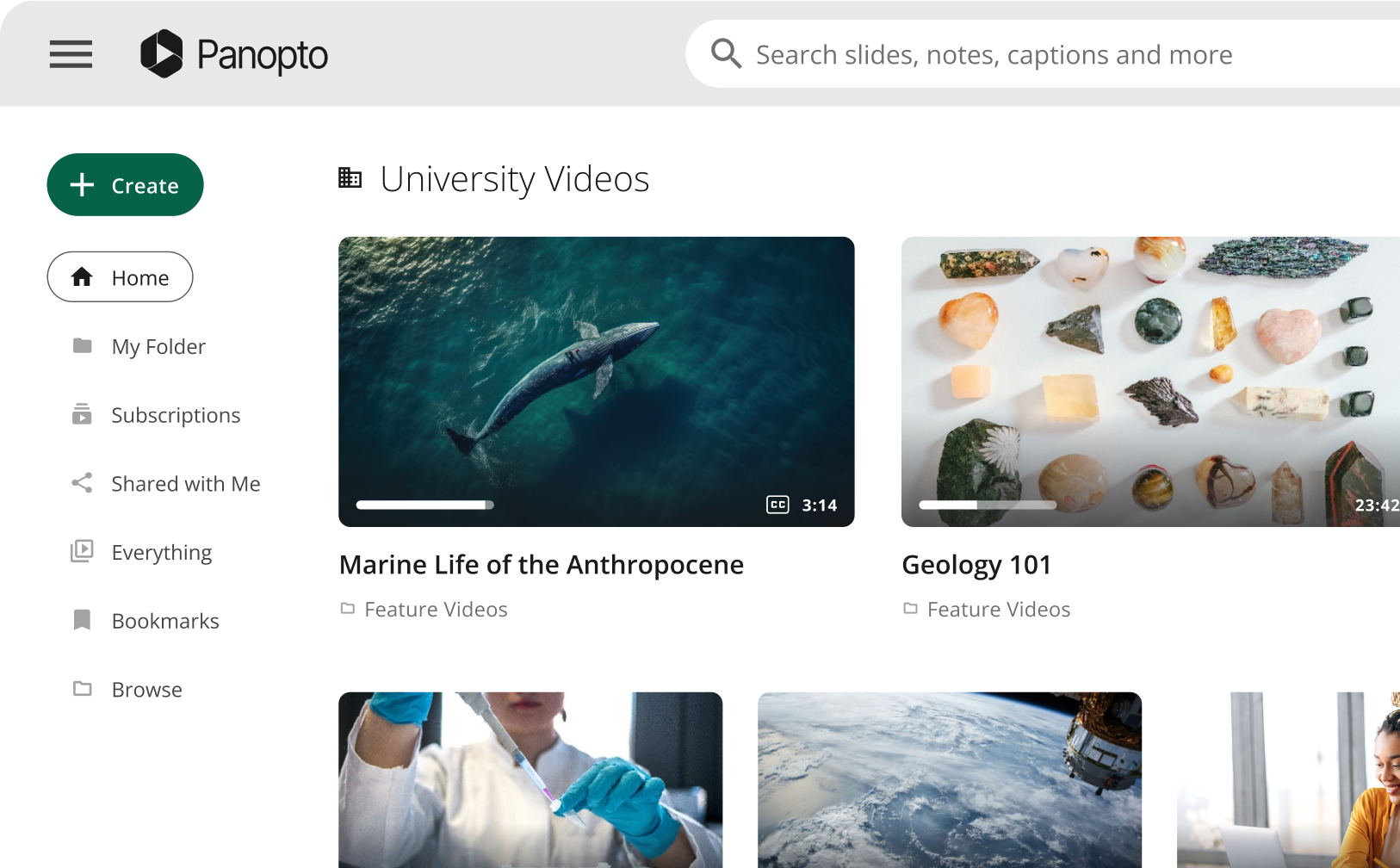
In the realm where 60% of employees struggle to find the information needed to do their jobs, our AI-powered video search makes every training resource instantly searchable by every word spoken or shown. Organizations implementing these solutions have reduced this friction by up to 60% based on customer use cases as learning shows up exactly when people need it.
Employee preferences clearly favor flexible, self-directed learning. Organizations using AI-powered learning solutions report a 20% increase in employee engagement and 15% increase in knowledge retention. Learning becomes accessible precisely when needed rather than through lengthy pre-work sessions. “Solutions pace with you,” Martins explained. “They test you as you’re doing things and repeat what you personally need more help with.”
Traditional metrics like completion rates don’t reveal whether learning created actual change. One manufacturing customer discovered employees repeatedly rewatching a specific 90-second safety video segment, revealing a knowledge gap. By overlaying learning data with operational data, they identified locations with higher error rates, added targeted content, and saw improvements within weeks.
Prompting as a Leadership Skill
Developing the ability to think with AI represents a critical capability. The quality of prompts determines whether AI creates dependency or builds judgment. A weak prompt simply requests AI to complete a task, while stronger approaches ask for critique, identification of blind spots, and analysis of trade-offs between options. “If AI just gives you the answers, then you get dependency,” Clark explained. “But if it builds judgment, you get capability.”
Demonstrable ROI
Research from Panopto and Newton X found 77% of organizations using video report that embedding it into workflows increases productivity. AI-enabled video-based learning has cut onboarding from 40 hours to 20 hours in documented cases. Panopto customers report a 24% improvement in skill test pass rates – evidence that learning was absorbed and applied rather than simply consumed.
A Practical Roadmap
Organizations must identify specific friction points before selecting technology solutions: repeatedly asked questions, new hire struggle points, and time-consuming updates. The piloting phase demands high-impact, low-risk use cases with moderately receptive teams that combine openness with realistic challenges.
Technology implementations rarely fail due to technology itself. Running parallel processes during implementation allows careful calibration while building confidence and protecting against errors. Organizations should start with constrained scenarios that can be closely monitored and controlled.
The fundamental principle is progress over perfection. Organizations that launch at 80% completion, learn through iteration, and maintain transparency achieve more sustainable adoption than those attempting perfection before rollout.
Looking Forward
The question isn’t whether to adopt AI-powered learning but how quickly organizations can close the gap between traditional models and modern work demands. Leading organizations are already embedding AI into daily workflows, creating environments where learning happens seamlessly alongside work rather than as a separate event. “This doesn’t require a massive transformation overnight,” Clark concluded. “It starts with one use case, one workflow, one moment where learning shows up faster and better than before.”
Organizations like Microsoft have pioneered this approach, coining the term “frontier firms” to describe workplaces where AI augments every employee’s capabilities. Those who embrace these changes position themselves to navigate continuous transformation with capable, engaged workforces ready for whatever challenges emerge next.