
- Webinar Recap
How Higher Ed is Using AI to Strengthen Teaching, Not Replace It

“AI needs us. It’s not the other way around. We as humans impact how AI is going to work for us at our institutions, and the more open we are to innovation, and also the more open we are to having conversations.”
In a landscape often dominated by fears of displacement, a recent webinar hosted by Panopto and Inside Higher Ed offered a refreshingly different perspective on artificial intelligence in higher education. Speakers Kuljit Dharni, Chief Product Officer at Panopto, and Michael A. Brown, Ph.D., Director of Educational Resources and Innovation for the Washington State Board for Community and Technical Colleges, presented a compelling case for AI as a strategic partner that strengthens educational systems while preserving irreplaceable human connections.
A Necessary Mindset Shift
The conversation centered on reframing AI implementation. “For me, what that means is a mindset change,” Brown explained. “Thinking of AI instead of a replacement, but an opportunity to improve capacity, to think about how we can strengthen our human connection.”
Rather than asking whether AI will replace faculty, the focus shifts to how it can be woven into existing systems to make them more equitable and human-centered. Dharni reinforced this philosophy, describing AI as an amplifier of great teaching rather than a substitute. In Panopto’s work, this translates into turning lectures into searchable, timestamped learning objects that give students who miss class, non-native speakers, or those needing more time the access required to succeed.
Washington’s Experimental Approach
Across Washington’s 34 community and technical colleges, Brown is witnessing widespread curiosity rather than resistance. Faculty members are actively experimenting because they see genuine potential. The approach focuses on sandbox environments where faculty can experiment without pressure, leading to innovative pedagogical shifts. Instead of banning AI, faculty are incorporating it as a thought partner, asking students to use it to iterate their work and explain their process, simultaneously building confidence and preparing them for workforce demands.
Human Workflow First
One of the most striking themes was designing AI implementation around human needs rather than technological capabilities. “The tool needs to facilitate and show improvement in learning outcomes,” Dharni emphasized. “That’s job number one.”
His seven-step framework progresses through faculty augmentation, equity and accessibility, privacy and data governance, interoperability, transparency, and vendor viability. The underlying principle: technology must remove friction, not create new silos. Tools requiring faculty to navigate multiple systems ultimately fail their users, regardless of technological sophistication.
Rethinking Academic Integrity
A compelling insight emerged around academic integrity: making AI more convenient for students may actually reduce cheating. “I’m a firm believer in the notion that everyone strives to be better and are inherently looking to do the right thing,” Dharni explained.
Students often turn to unauthorized AI use out of desperation, overwhelmed by information overload. When institutions provide sanctioned AI tools that help students summarize materials, translate content, or generate practice quizzes, engagement with appropriate resources increases significantly. This recognizes that students fundamentally enter higher education to learn and will choose legitimate pathways when accessible and effective.
Closing Equity Gaps
Both speakers saw enormous potential for AI to address existing inequities. Institutions are often data-rich but insight-poor, having vast information without tools to extract meaningful patterns for targeted interventions. However, successful implementation requires incorporating voices with equity expertise to guide intentional engagement. Accessibility features cannot be afterthoughts; compliance standards and multilingual capabilities should be fundamental means of engagement from the start.
Mission Before Tools
Successful AI adoption begins with institutional mission, not technological capability. Tools should be evaluated against whether they advance or distract from core goals like access, equity, student success, and workforce development. This mission-first approach requires inclusive conversations bringing together voices from across institutions: advisors, librarians, financial aid personnel, and anyone interacting with students daily.
What Makes This Moment Different
Unlike previous educational technology waves that spread gradually, AI touches every institutional touchpoint simultaneously, forcing systematic thinking across organizations. Three factors distinguish this moment: unprecedented real-time adaptability allowing tools to adjust to individual learners; universal presence across industries enabling cross-sector learning; and realistic potential for delivering high-quality, personalized learning at scale without compromising on-campus experiences.
The Path Forward
The most successful institutions recognize that technology matures faster than policies ever will, requiring action over perfection through small pilots and cross-functional working groups. “Change is rooted in the past, and transformation is rooted in the future,” Brown noted. The institutions that will thrive are those understanding the difference, choosing transformation with intentionality, keeping mission and human connection at the center.
Latest News
-
- Remote Work
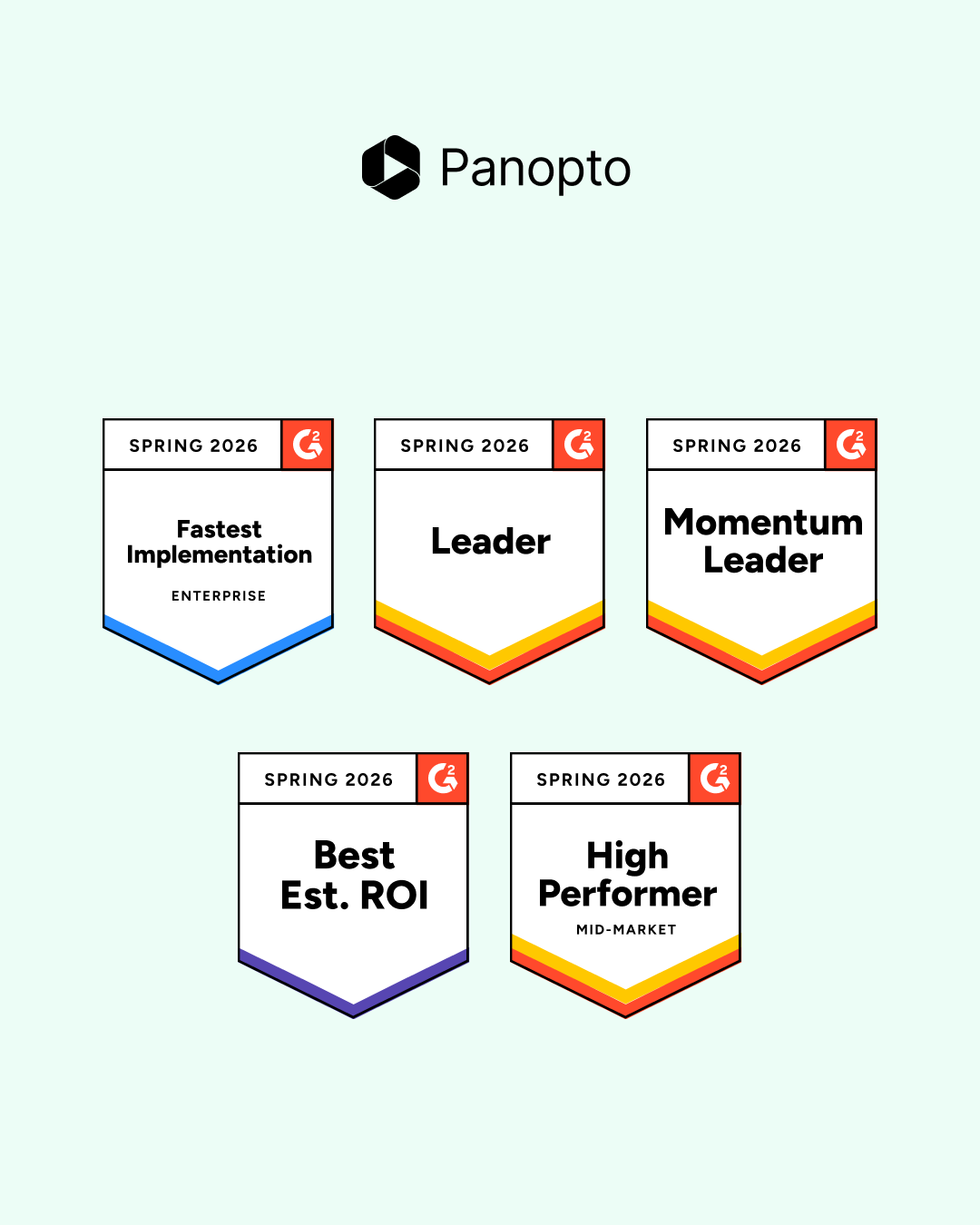
How Our Customers Made Panopto a G2 Spring 2026 Leader
We’re proud to support the customers whose feedback and real-world outcomes led to Panopto being recognized with multiple G2 Spring 2026 badges. This season, Panopto earned Leader, Momentum Leader, High Performer, Fastest Implementation, and Best Estimated ROI badges across multiple G2 Spring 2026 Reports, based on its performance within the Video Communications, Video CMS, Virtual…
How Our Customers Made Panopto a G2 Spring 2026 Leader
-

- Enterprise Video Platform
Best Video Management Platforms for Training and L&D Teams in 2026
Most video platforms were built for marketing teams. They track clicks, conversions, and ad performance. That’s useful if you’re selling a product. It’s not useful if you’re training 5,000 employees on updated compliance procedures and need to know who actually watched the whole thing. Training teams have a different set of problems to solve. You…
Best Video Management Platforms for Training and L&D Teams in 2026
-

- Webinar Recap
Beyond the Prompt: Key Webinar Insights on AI as a Strategic Thought Partner
The landscape of Artificial Intelligence in Learning and Development has reached a critical tipping point. It is no longer a question of whether organizations are introducing these tools, especially as AI adoption jumped from 55% to 78% in the last year alone. Instead, the focus has shifted to whether they are using it to move…
Beyond the Prompt: Key Webinar Insights on AI as a Strategic Thought Partner