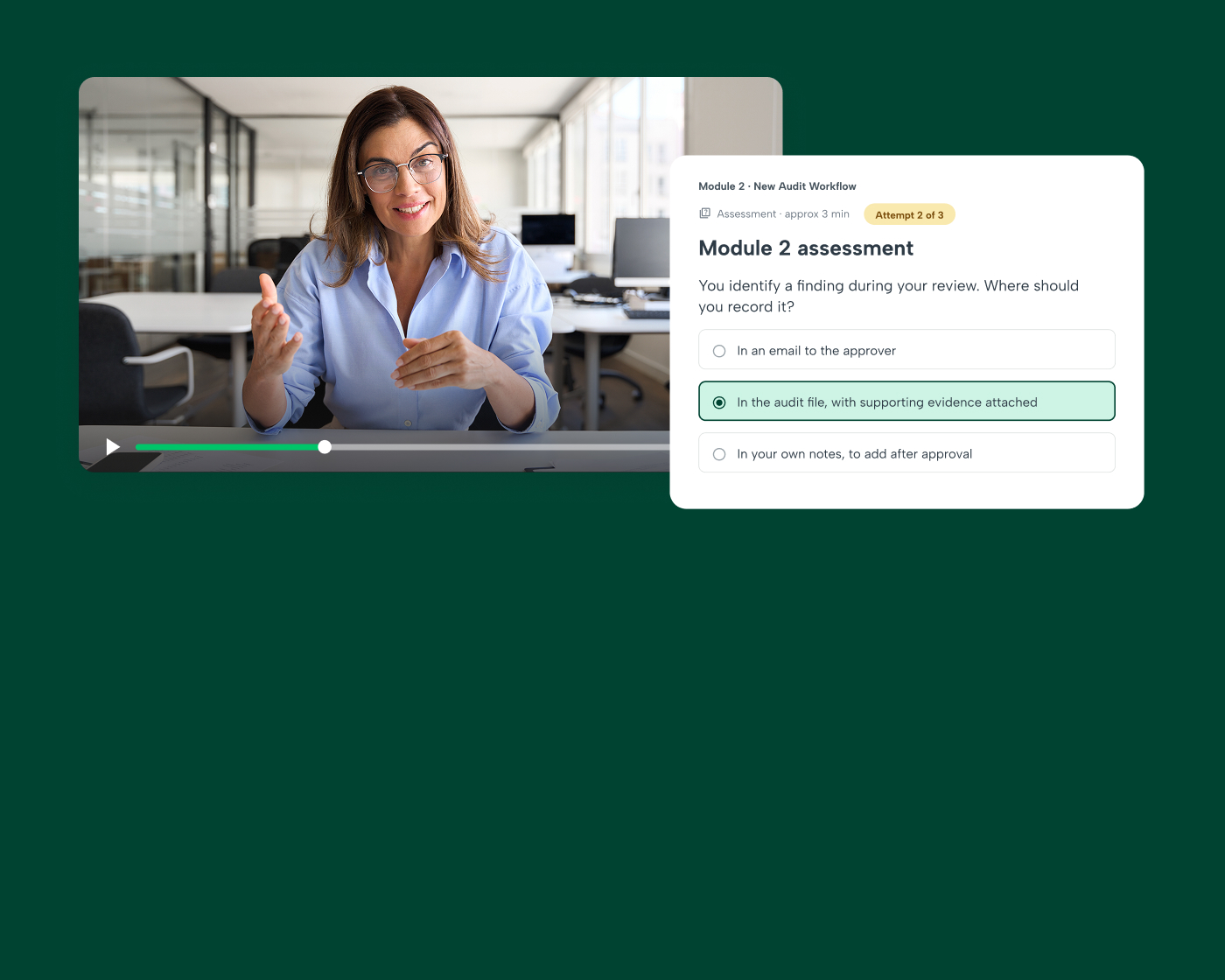









A safety program can use both kinds of video. Off-the-shelf safety training videos cover general topics, such as ladder safety or personal protective equipment basics, quickly and at low cost. Custom videos cover your lockout/tagout procedures, equipment, site hazards, and language, which matters because several OSHA standards require workplace-specific training. Either kind of video works as one part of that training, alongside hands-on practice and a qualified trainer.
The decision safety leaders face
Safety leaders in manufacturing, energy, and utilities can buy a video library, make their own videos, or use both. Libraries are easy to buy and quick to roll out, while custom video carries a reputation for high cost and long production times.
Generic content shows another company’s facility, equipment, layout, and procedures. “Generic safety courses rarely change behavior,” writes the National Association of Safety Professionals.
This article covers:
- What off-the-shelf video does well
- Which OSHA standards call for training specific to your site
- What custom video costs now
- How to run both together
Each section helps you decide where a library fits and where your own recordings fit.
What off-the-shelf safety video does well
Off-the-shelf libraries offer a broad range of topics from the start. J. J. Keller offers 950+ online e-learning courses and 300+ streaming training videos, with training in Spanish as well as English and availability varying by course. Many of its courses and videos download in SCORM 1.2 and MP4 formats for a learning management system (LMS).
Libraries also keep the cost per learner low. Safetyhub states that its plans average $14.95 per employee per year after the free trial. That gives buyers a figure to compare with custom production costs.
Off-the-shelf video fits general awareness topics, where the content applies the same way at every site. A team that picks a library for those topics gets broad coverage quickly and saves recording time for other subjects. Teams can start with a library for general topics while they record custom videos for the rest. Some topics depend on the site, and OSHA’s training standards name several.
Where OSHA requires training specific to your workplace
OSHA’s standards call for workplace-specific training in several places, and the sections below cover three standards, a language policy, and one interpretation of computer-based training.
Lockout/tagout
OSHA’s standard on the control of hazardous energy (1910.147) requires that energy control procedures be “developed, documented, and utilized.” Each authorized employee receives training in recognizing “applicable hazardous energy sources.” The employer certifies training with “each employee’s name and dates of training.”
Powered industrial trucks
Formal instruction under powered industrial trucks (1910.178(l)) can include “video tape.” Training also covers “workplace-related topics” and includes an “evaluation of the operator’s performance in the workplace.” The employer certifies each operator’s training and evaluation, including the operator’s name, training date, and evaluation date.
Hazard communication
Hazard communication (1910.1200(h)) requires training on hazardous chemicals “in their work area.” Training also covers “the details of the hazard communication program developed by the employer.”
Other OSHA requirements and guidelines
In its OSHA Training Standards Policy Statement, OSHA states that an employer “must instruct its employees using both a language and vocabulary that the employees can understand.” The statement applies to OSHA’s training standards.
OSHA guidance on the appropriateness of computer-based interactive training programs to satisfy required OSHA training states that “use of computer-based training by itself would not be sufficient to meet the intent of most of OSHA’s training requirements.” The letter says trainees need “an opportunity to ask questions.” That means some combination of formal instruction, practical training, and evaluation.
Your safety counsel can confirm which requirements apply to your facility.
What custom safety video costs now
Production cost depends on who makes the video. This section compares an agency with an in-house recorder. Vidico, a video production company, estimates that agency production of corporate and explainer video costs $1,000 to $10,000 per finished minute (September 2026).
In-house capture changes the math. Using a platform like Panopto in-house, a supervisor who knows the machine records the lockout sequence on that machine with a phone or a browser. The supervisor uploads the recording to Panopto, so the video shows the procedure as the site performs it. Panopto Express records screen, camera, and audio for free in the browser, and Panopto mobile apps record and upload from the floor.
Ingersoll Rand reports that Panopto cut “video production timelines from 10 weeks to instant.”
Running custom and off-the-shelf video
The left column lists topics that read the same at any site, which makes them more suitable for off-the-shelf video. The right column lists topics that depend on your equipment, layout, and procedures, which custom video works best for.
| Use off-the-shelf for | Make custom video for |
| General awareness, such as personal protective equipment basics, slips and falls, and ergonomics | Your lockout/tagout procedure on each machine |
| Regulatory overviews | Forklift routes, docks, and pedestrian areas at your site |
| Onboarding fundamentals | Your hazard communication program, labels, and chemical locations |
| Topics that rarely change | Procedures that change with equipment or process |
Put both kinds of video in one searchable place so workers can find the right clip later. A worker who needs a refresher on a lockout step then searches one library, whether the clip came from a vendor or from the site.
Making custom safety video findable and measurable
A safety training video platform stores custom videos where workers can find them and where managers can measure their use.
Workers can open the exact procedure at the machine. Toyoda Iron Works attaches QR codes to equipment on the factory floor. Employees scan them with a smartphone to watch the training video they need. The company reports 50% faster onboarding, from 40 hours to 20, and a 24% higher National Trades Skills Test pass rate.
Workers can find the exact step by searching. Panopto indexes spoken and on-screen words, so a search for “isolation valve” can lead to the minute of a 20-minute walkthrough where that term appears.
Workers can watch in their own language. AI captions and translation produce captions in other languages. OSHA’s standard requires workers to understand the training, so pair translated captions with human review of safety-critical wording.
Managers can see who watched and how much. Panopto’s analytics show per-viewer watch time and completion, and managers export reports to support training records. The employer’s certification records stay with the employer. Training records then draw on two sources: viewing analytics and the employer’s certification for the training itself.
Teams can also use video to capture what experienced employees know. Framatome, a nuclear company, used Panopto to capture expert knowledge.
What the research says about effectiveness
Findable, measurable video works best alongside practice. Research on training methods points the same way.
The 2006 meta-analysis Relative Effectiveness of Worker Safety and Health Training Methods covered 95 studies and 20,991 workers. It showed that methods requiring active participation, such as behavioral modeling and hands-on training, produced greater knowledge gains. Those methods also produced larger reductions in accidents, illnesses, and injuries than lectures, pamphlets, and videos. The analysis suggests that all training methods improved safety performance.
These results support pairing video with practice. Library videos cover general topics, custom videos cover site-specific topics, and hands-on practice with a qualified trainer accompanies both.
Frequently asked questions
Do off-the-shelf safety videos meet OSHA requirements?
Off-the-shelf videos can cover general instruction. Several standards also call for workplace-specific training and evaluation, including lockout/tagout, powered industrial trucks, and hazard communication. Custom video and hands-on practice cover those parts.
Is video training alone enough for OSHA?
Video works as one part of OSHA training. OSHA’s June 11, 1997, letter states that computer-based training “by itself would not be sufficient to meet the intent of most of OSHA’s training requirements” and that trainees need “an opportunity to ask questions.” The forklift standard also calls for practical training and an evaluation of the operator’s performance in the workplace.
Which OSHA standards require site-specific training?
Lockout/tagout, powered industrial trucks, and hazard communication each include workplace-specific training. Lockout/tagout training covers the applicable hazardous energy sources, forklift training includes workplace-related topics, and hazard communication training covers the hazardous chemicals in each work area. The full text of each is on OSHA.gov at 1910.147, 1910.178, and 1910.1200.
How much does a custom safety training video cost?
Vidico, a video production company, estimates that agency production of corporate and explainer video costs $1,000 to $10,000 per finished minute (September 2026). Recording in-house with a phone or Panopto Express avoids agency production fees, and the supervisor who runs the machine can record the task.
How do you make safety training videos in-house?
Record the task on the equipment where it takes place, using a phone or a browser. A qualified trainer reviews the recording, and the team publishes it to a searchable library.
How do you prove employees watched safety training?
Per-viewer analytics show who watched and how much. The employer’s certification records document the training itself, as required by the lockout/tagout and powered industrial trucks standards.