








Your most experienced operator is teaching the new hire today. They are not running their station. They are not solving the failure mode that took them seven years to recognize. Both costs are real, but only one is on the production schedule.
For mid-to-large manufacturers with multi-shift, multi-site operations, the productivity drain is what you pay when senior operators become the training system. Every hour the SME spends teaching is an hour the line runs without its strongest hand and an hour their specialized knowledge is not on call. The drain compounds quietly until the day the SME retires and takes the only working copy of the procedure with them.
Why do experienced operators get pulled into training in the first place?
Experienced operators get pulled into training because the assumption baked into most plants is that the best operator is the best trainer. They know how the procedure actually goes. They know the failure modes the SOP does not document. They are credible to the trainee because they live the work, and that credibility is real.
That assumption is right about credibility and wrong about scaling. SOPs document the procedure, but not the institutional knowledge experienced operators carry: how to read the line when a quality issue starts trending, how to recover from a failure mode that only shows up under specific conditions, how to set up the machine faster than the spec says it should take. That know-how lives in the heads of the people who built it.
Multi-shift, multi-site operations spread the same procedure across teams the SME never meets. Retirements pull tenured operators out of the workforce faster than new hires accumulate the experience the SME spent fifteen years building. The bottleneck is structural, and most plants meet it the only way they know how, by sending the senior operator down to the floor to teach.
What does using your best operators as trainers actually cost?
Using your best operators as trainers costs in four places at once: lost production hours, training quality that varies with the SME’s schedule and energy, ramp times that stretch as the SME runs out of time, and retirement risk that grows quietly until the day the SME walks out the door. The bill is paid in production data, in onboarding metrics, and eventually in the line’s downtime numbers.
Production runs without its strongest hand when the SME is teaching. Training quality varies with whichever version of the procedure the SME walks through that day. Ramp time stretches because every new hire bottlenecks on the SME’s calendar. Retirement risk compounds: when the SME walks out without a captured walkthrough, every future appearance of that failure mode becomes a longer downtime event.
The 2024 Deloitte and Manufacturing Institute study Taking Charge: Manufacturers Support Growth with Active Workforce Strategies models the labor-supply pressure manufacturers will face as boomer retirements, skills mismatches, and demand growth compound over the coming decade. The durable point: workforce strategy is now an operations problem, not an HR one. Manufacturers solving it are treating knowledge transfer as infrastructure, not a one-time onboarding event.
Why don’t the standard fixes take the load off senior operators?
The standard fixes do not take the load off senior operators because each one solves part of the problem and leaves the institutional knowledge stuck in the SME’s head. Four common attempts and why each falls short:
Updated SOPs. SOPs document the procedure but not how it is performed. The cadence, the small recoveries, and the reads on the line an experienced operator picks up by feel never make it onto the page. New hires learn the words and still need the SME to demonstrate the work.
Outside trainers. Outside trainers know training, but they do not know your line. The SME still has to bridge the gap before the new hire is productive on the floor.
More LMS modules. More LMS modules add coursework on top of an already busy onboarding plan, but the SME’s know-how is not in the LMS. The new hire completes the modules and still needs the SME for the part that matters.
Peer trainers. Peer trainers spread the load to a smaller group, but each one is still a single point of failure with their own schedule and their own version of the procedure. The bottleneck moves; it does not disappear.
The category-level fix is to capture how the SME actually performs the work, once, in a format that survives a shift change and a retirement, and put it where every operator can reach it at the workstation. Manufacturing knowledge management starts when expert know-how lives in a searchable video library, not in one operator’s head.
How does Panopto turn SME walkthroughs into reusable training?
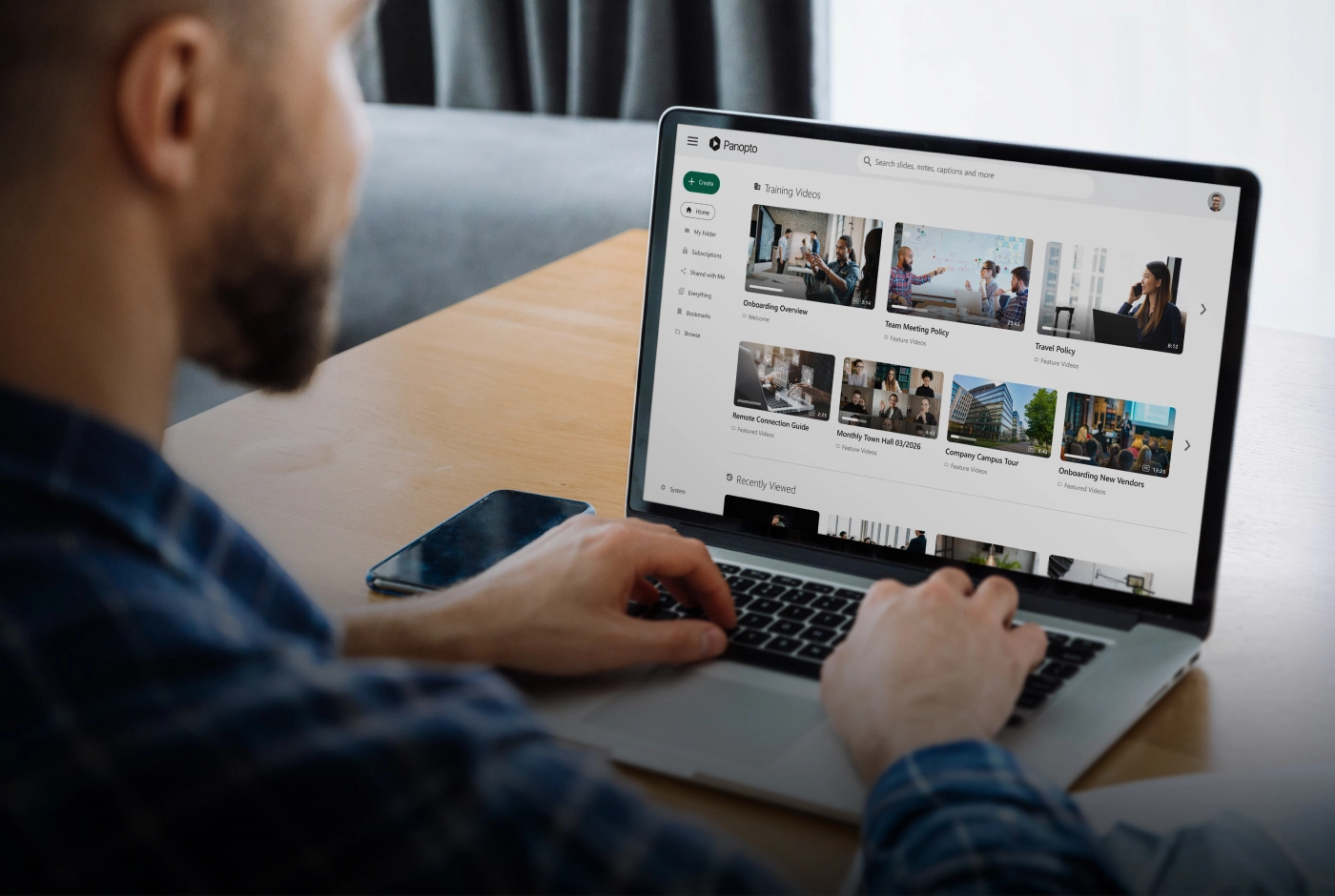
Panopto turns SME walkthroughs into reusable training by capturing one recording, indexing every word and on-screen text, governing it as a single source of truth, and delivering it to operators at the workstation. Seven capabilities operationalize the layer.
Capture institutional knowledge before it walks out the door. Tenured operators record one walkthrough via webcam, screen capture, or auto-ingest from Microsoft Teams, Zoom, and Webex sessions (video recording, Teams, Zoom, Webex). The walkthrough that used to live in one expert’s head becomes a clip every shift can reach.
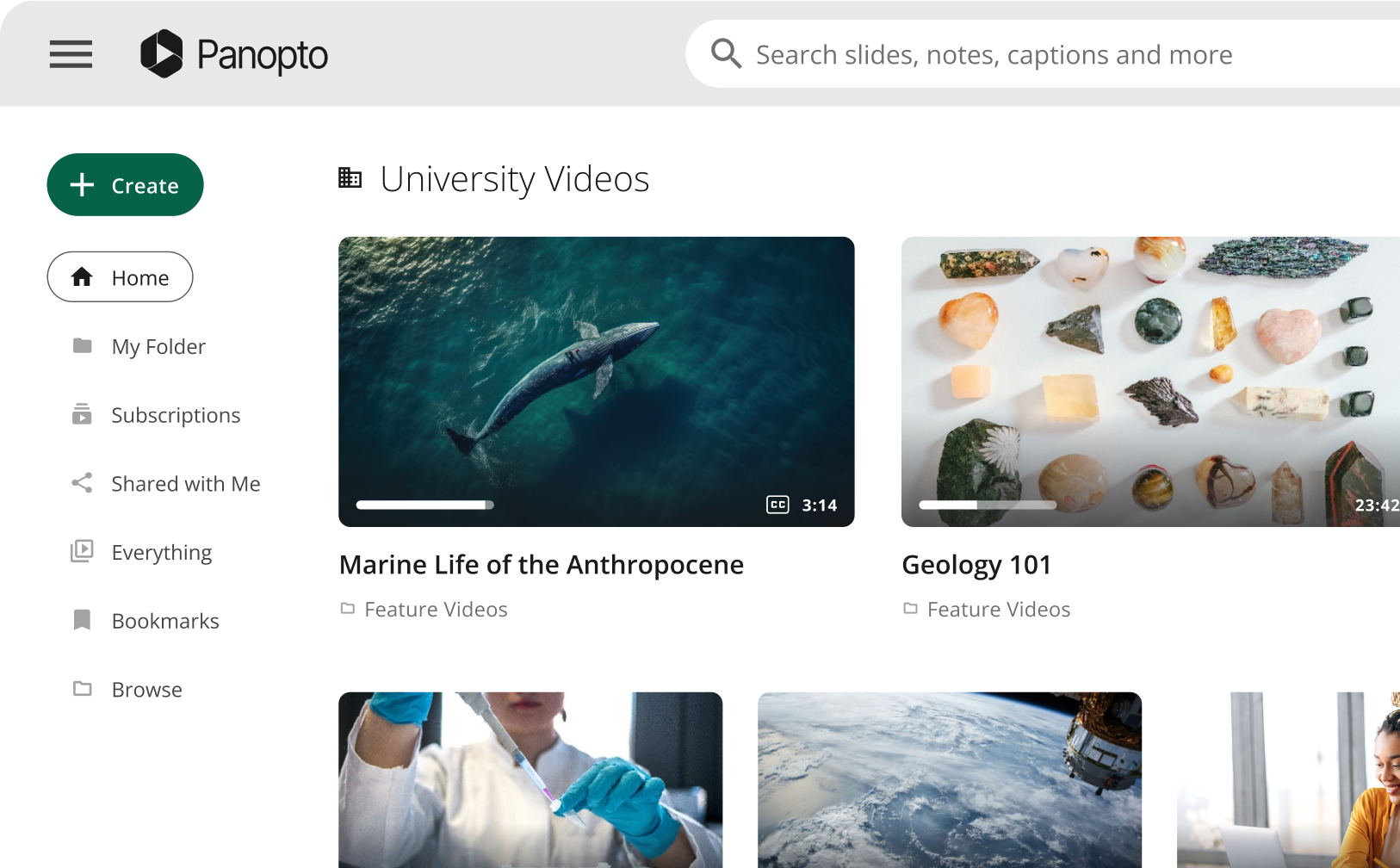
Make every word findable. Panopto’s Smart Search indexes spoken word and on-screen text, so a new operator locates a specific procedure step inside a longer recording in seconds. The underlying capability sits in Panopto’s AI layer.
Centralize as one source of truth. A centralized video CMS gives plants role-based access, version control, and an audit trail. The library survives shift changes and turnover. This is the foundation of knowledge sharing at the plant level.
Train across language boundaries. Multi-language captions deliver the same procedure to multi-language workforces without rebuilding it.
Reach operators where the work happens. Mobile delivery covers tablets, kiosks, and offline playback for the floor.
Deploy through your existing LMS. Native LMS integrations with Cornerstone, Canvas, Blackboard, Moodle, and D2L mean the LMS continues to assign and track.
See what is actually getting used. Tracking and analytics show plant managers which clips are watched, where operators rewind, and where comprehension drops.
How did Framatome capture 60 years of expert knowledge?
Framatome, a global nuclear-industrial manufacturer, used Panopto to centralize 60 years of expert knowledge before it walked out the door. In the first six months of deployment, teams created more than 1,000 videos. The platform now runs across 58 locations.
The problem was the one this article describes. A wave of retiring senior experts whose knowledge had never been captured in a form anyone else could use, sitting between teams and locations that needed to learn the same procedures the same way. The choice to centralize the company’s video knowledge in a single, searchable platform meant the next generation of engineers and operators could learn from the people who built the line, even after those people retired.
“Panopto quickly became one of the most appreciated tools for users. We felt like we had a real partner in Panopto,” said Jean-Paul Taravella, Project Manager for the Knowledge Program at Framatome.
Stop the drain at the source
The fix is not to stop using your best operators as trainers. It is to capture what they know once, in a video CMS for just-in-time training, and let every shift learn from it without taking the SME off the line. To see how that deploys in your operation, schedule a demo.
Frequently asked questions
Why do experienced manufacturing operators get pulled into training?
Experienced operators get pulled into training because the institutional knowledge new hires need lives in their heads, not in the SOP binder or the LMS. The senior operator is the most credible source for how the work actually gets done, which is why most plants default to using them as the training system.
What is the hidden cost of using senior operators as trainers?
The hidden cost is paid in lost production hours, training quality that varies by the SME’s schedule, ramp times that bottleneck on one calendar, and retirement risk that grows quietly until the SME leaves. Each cost shows up in different metrics, which is why the drain stays invisible until it compounds.
How can manufacturers transfer institutional knowledge without losing production time?
Manufacturers transfer institutional knowledge without losing production time by capturing the SME’s walkthrough once on video, indexing it for search, and storing it in a centralized video CMS that operators reach from a tablet or kiosk. The SME records once and trains every shift after.
What is manufacturing knowledge management?
Manufacturing knowledge management is the practice of capturing, governing, and distributing the institutional know-how that keeps a line running, including the failure modes, recoveries, and setup tricks that SOPs do not document. A searchable video knowledge base is the system most large manufacturers use to make the practice scale across shifts and sites.